13 June 2015

Batam - Casio Nongsa Cycle 2015 with Casio EX-FR10

Date of Cycle : 9 - 10 May 2015

Putting medals to the pedals, the inaugural Casio Nongsa Cycle 2015 rolled off to a brisk start by attracting close to 200 cyclists from around the region to participate in this cycling event. Held in Batam (Riau, Indonesia), the event caters to both competitive racers as well as leisure cycling enthusiasts and spotlights the island's potential as a destination for long-distance pedalling.

Although my speed on the two-wheeler is about as fast as a sloth on its most active day, I decided to accept the invitation by Casio Singapore to take part in the race. Not to win, hell no, not with my 16km/h crawl compared to the 28km/h average speed of pro racers, but to explore the possibilities of going on weekend cycling vacays in Batam and test drive the Casio EX-FR10 action camera.

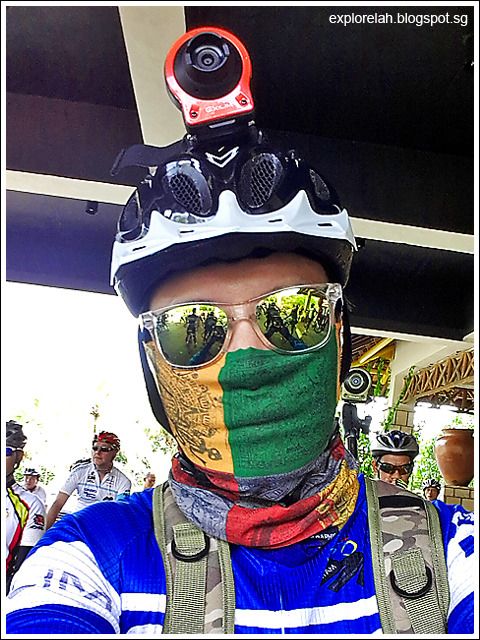
Trying my best to look the part of a pro racer. Pass or not? Heh heh...

The starting point was at Nongsa Ferry Terminal. Batam island consists of a number of key districts served by a couple of ferry terminals scattered across the island.

The Nongsa district, about an hour by car from the island's busy downtown area known as Batam Center, is a much quieter part of the island with a couple of high-end resorts located here. Nongsa is also where the best beaches on the island can be found.

Being an enthusiast of bicycle touring, I've been thinking of getting an action cam to record my cycling trips but found single-screened cams rather restrictive as I can't see what I'm filming.

Casio EX-FR10 comes with a camera that can be detached from its viewing screen so that I can mount the screen on the bicycle handle and see the footages I'm shooting and make adjustments. The screen also serves as a touchscreen control panel to turn the camera on or off and choose shooting modes such as single photo, video, or time-lapse video. This camera also makes taking selfies easier as I can frame the shot by looking at the detached screen and using it to take a shot remotely. My only grouse is that the screen's luminance is rather low under natural lighting conditions and hard to see.

Getting ready to roll off... this is the only moment I managed to capture the racers behind me because as soon as the starter horn sounded, they zoomed past me and disappeared in the blink of an eye!


But not all who took part in Casio Nongsa Cycle are professional racers. There are other leisure cyclists like me who are in it for the exercise and thrill of a self-powered road trip.

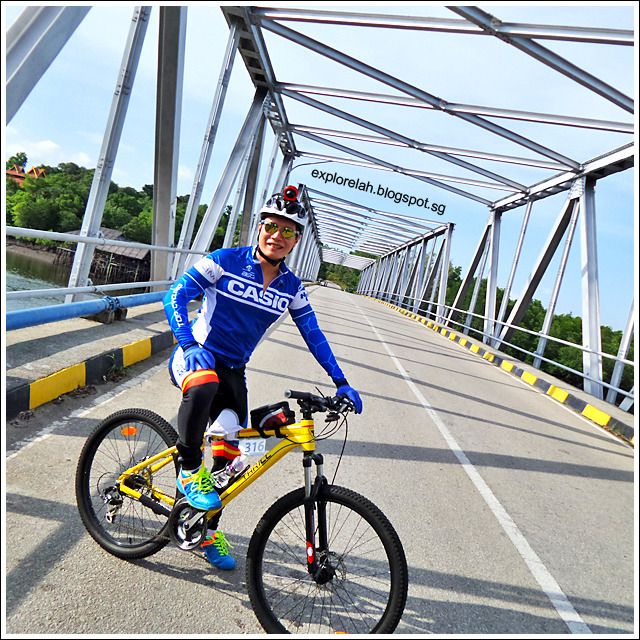
This vehicular bridge straddling an estuary below is found near Nongsa Ferry Terminal and the most scenic stretch of my ride. Scenery-wise, there's not much to see as the 12km cycling route at Nongsa follows a loop from the ferry terminal that passes by a couple of small villages and private resorts.

Compared to the choked roads in Batam Centre, Nongsa's lighter traffic and well-paved roads make for a safer and less stressful cycling experience.

Taking a shot with Casio EX-FR10 with the detached screen and control panel. Recording the journey is definitely much more flexible with this action cam as I can change between photo mode, video mode or shooting time-lapse easily.

This insane upslope gave my eyeballs a heart attack! The toughest section of the entire 12km cycling route is this 1km long steep climb at 70 degrees elevation that seriously burns the thighs and aches the lungs. The tougher the challenge, the greater that sense of achievement in overcoming it. So yeah, I felt great reaching the top!

Then came the realisation that I have to climb this slope 4 more times as I 've signed up for the 60km ride. The route goes in a circle and each loop is 12km so I have to complete 5 rounds to clock 60km. Imagine those who registered for the 120km full marathon! After the initial shock of encountering this monster, it became rather monotonous to climb it but it sure fired up the adrenalin.

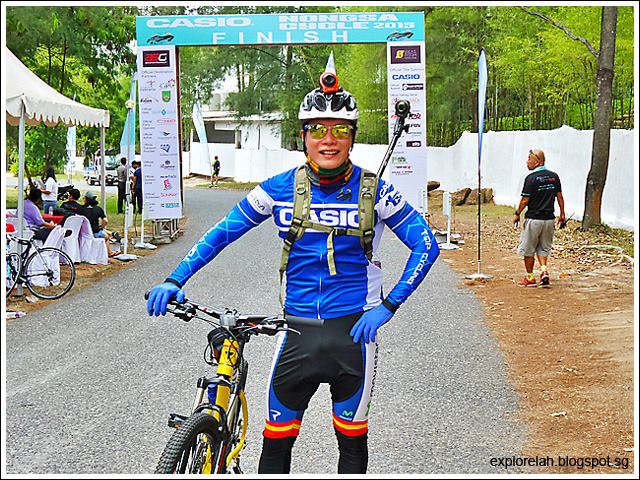
After an exhausting 4 hours, I completed my first bike-a-thon challenge! I may be smiling but my ass felt like it was on fire. I guess that's how buns of steel are forged right? LOL.
As this is my first marathon cycling event, I have no basis to gauge the logistics of Casio Nongsa Cycle but I think it was pretty well organised. Hopefully the event will gain traction to feature annually on the region's sporting calendar.

A 2D1N Nongsa Cycle early bird package cost about S$350 per pax (twin share) and includes ferry transfers from Tanah Merah Ferry Terminal to Nongsa Ferry Terminal, bicycle handling, land transfers, hotel stay, race pack, jersey, medal, and celebratory dinner.

Outside of the Nongsa Cycle event, you can bring your own bikes over from Singapore onboard the ferry to Nongsa for a cycling trip. A bicycle handling fee of S$10 is levied.

The less populated Nongsa district is suitable for an easy cycling weekend getaway to explore the tranquil side of Batam away from the downtown hustle and bustle. But we still got our shopping and massages done after the race by hopping on the free shuttle bus provided by Batam View Resort Hotel (where we stayed) to Batam Center's Nagoya Hill Shopping Mall.

If you are a seasoned cyclist, you can consider arriving at Nongsa, cycle from Nongsa to Batam Center (approx. 28km according to Google map), stay a night and return to Singapore via Batam Center Ferry Terminal. There aren't that many arterial roads on the island so I think way-finding should be pretty straightforward although sign posts may be lacking. Perhaps I'll try this route one day. Or if you've done it, please share the experience and tips with me :)

This being my first attempt at a competitive cycling event, I was more focused on catching up with the pros, which I failed miserably, than taking more shots and videos with Casio EX-FR10. Below is a video shot by my fellow cyclist Danny for a preview of the action camera's performance as well as scenery along the 12km Nongsa cycling route. Hopefully it'll inspire you to bring your wheels overseas with wonderful memories to keep...


This post has been made possible by Casio Singapore.

08 June 2015

Singapore - The Projector Cinema : Silver Screens from a Golden Era

Date of Exploration : 9 Apr 2015

Lights, Camera, Retrospection!

It's showtime for the last remaining "old face" of Singapore's cinematic history through The Projector, an independent movie house that has resurrected the defunct Golden Cinema into a hipster-approved entertainment joint.

With over 230 state-of-the-art cinemas from 8 movie theatre operators on our tiny red dot, we are spoilt for choices of convenience and comfort to escape into a celluloid world. But for a truly unique movie-going experience, The Projector is the place to be. Watching a show here feels like walking onto a life-size movie set of a 1970s cinema!

Lock, stock and barrel is how The Projector has restored the theatre halls of the former Golden Cinema. As new developments and re-developments have brought on urban amnesia, there are not many places like The Projector left in Singapore to frolic with nostalgia.
Getting to The Projector

Housed within the front annexe building of Golden Mile Tower (not to be confused with Golden Mile Complex next to it), you can get here...

By Bus - Hop on bus numbers 100, 961 or 980 headed in the direction of Beach Road.

By MRT (the nearest MRT stations are Nicoll Highway and Lavender)

1) From Nicoll Highway MRT Station (Circle Line), walk towards The Concourse building. Golden Mile Tower is across the street next to The Concourse along Beach Road. Walking time is approximately 5 minutes.

2) From Lavender MRT Station (East-West Line), take the exit of the Immigration and Checkpoint Authority (ICA). Walk towards the North Beach Road HDB housing estate across the river and cut through the HDB flats in the direction of Beach Road. Cross an overhead bridge near Golden Mile Hawker Centre to Golden Mile Tower. Walking time is approximately 8 minutes.

Top Left : Bridge-way leading from Nicoll Highway MRT Station at Republic Avenue to The Concourse. Top Right : Snapshot of Golden Mile Tower from the bridge-way. Bottom Right : Golden Mile Tower is across a side street from The Concourse and next to St John Headquarters along Beach Road. Bottom Right : View of Golden Mile Tower from ground level.

Designed by pioneer architect Goh Hock Guan and completed in 1975, Golden Mile Tower is fashioned after the béton-brut French architectural style popular between the 1950s to the 1970s. Béton-brut means "raw concrete" and this genre of design concept is known as Brutalist Architecture.  
Golden Mile Tower counts its heydays as being home to Golden Cinema, which was the biggest cinema in Singapore and Malaysia during the yester-years with a seating capacity of 1,500. It screened mostly Chinese movies until the 1990s when the theatre was split to showcase Hindi and Tamil films.

Today, Golden Cinema comprises The Projector that showcases Indie films on level 5 and the original Golden Cinema that continues to screen Hindi/Tamil movies on level 3.

Rewind to Yesterday

The Projector is conceived through a collaboration between Pocket Projects, a creative development consultancy and management company, and FARM, a cross disciplinary design practice, architecture atelier, and community-centered arts organization. More than just preserving a piece of Singapore's history, the creators hope that The Projector will serve as a creative platform for the local arts scene as well as an alternative to mainstream cinema.

Movies screened here have been carefully curated by film consultancy firm Luna Films, who widens the entertainment choice by bringing in Indie movies and controversial titles worldwide that otherwise won't make it to conventional local cinemas.

Lift foyer on ground level of Golden Mile Tower. To get to The Projector, take either lift to level 5.

I thought the logo simulating a projection is very apt and creative.

A roof of old movie posters makes the lift feel like a time machine of sorts. But if you really want that extra old-world feel...

... take the retro-classic spiral staircase that's opposite the lifts. It's pretty captivating to look up the swirls from the bottom of the stairs.

Feels like I'm winding my way through the intestine of time with the helical climb up.

Though simple and plain, the stairwell is one of the last places in Singapore to admire the beauty of a logarithmic spiral. I would suggest taking the lift up and then going down by the stairs.

As the lift door opens or coming atop the stairway, you will be greeted by the entrance hall of The Projector where modernist furnishings try not to interfere with the period ambience.

Box office is a small counter at a corner. Full-price tickets cost about S$13 and you can check for shows that are screening at The Projector website. The cool thing about The Projector is that you can swig a beer (S$10) while enjoying a movie! I washed my tongue with Dream Machine (S$10). I wondered what kind of machine made the dream a wet one...

Tidbits are on sale and the low tech way of displaying show posters brought back lost memories.


This door knob looks like it survived the 70s to this day.

Before we have more font faces than there are words, a simple directory found along the stairway replicated font types used in the yester years. Meanwhile, a comic artist injected modern funk on the wall outside The Projector's cinematic halls.

With all those shades on, it seems odd that the characters are queuing up to watch a movie. I'm all for updating an old space with contemporary pizzazz but this feels a tad 勉强 (trying too hard). Golden Cinema should be allowed to bask in the allure of its age.

There are 2 cinematic halls at The Projector - the Red Room (pictured here) and the Green Room.

I immediately felt a rush of familiarity when I saw these folding cinema chairs. I could almost see my 9-year-old self sitting in one of them. Back then, there were no 3D screens, neither the 5.1 or 7.1 Surround Sound, nor the DTS audio system.

While the seats have been upholstered for comfort, the hand rails and floorings remained as they are originally. The Red Room is generally reserved for private event bookings.

Why sit back and relax when you can lean back and enjoy the show on these beanies? Cool idea... yes?

The Green Room is where most of the public movie screenings take places.

The cinematic halls may be vintage but the entertainment is state-of-the-art. We caught The Birdman in the Green Room and although the seats weren't as comfortable, the movie somehow felt closer without the heavily cushioned seatings of today's cinemas.

There are many things we can find easily in Singapore, but the opportunity to immerse in authentic sentimentality is like searching for a needle in the haystack. While catching a movie in the old cinema of The Projector is an unusual experience, the novelty worn out pretty quickly for me. So would I come back again?

Yes. Borrowing a phrase from Terminator, "I would be back". But not for the antiqued charm. I'll come back again because of the air of casualness that comes with going back to basics. And also because I can drink beer while watching a movie!

The Projector

Address : 6001 Beach Rd, Golden Mile Tower, #05-00, Singapore 199589
Website : theprojector.sg

08 May 2015

Malacca Through the Lens of Casio Exilim EX-ZR3500

Date of Exploration : 25 Apr 2015

I visited Malacca in 2010 and captured the trip with a DSLR (read about it here). Five years later, I'm back to the historic city and documenting the sights with the nifty Casio Exilim EX-ZR35000 compact camera.

When I posted on Facebook that I'm photographing Malacca with a compact camera, an acquaintance asked why I "downgraded" and called me a "traitor". Harsh words. But I don't see it as a downgrade in imaging equipment, I see it as an upgrade in convenience. And with a powerful compact cam like the EX-ZR3500 that comes with various in-camera filters and creative imaging modes, photography becomes an opportunity to play and experiment for all occasions while I'm enjoying a vacation!

Our trip to Malacca was organised by the good folks at Casio to test-drive the EX-ZR3500. The camera comes in 4 colours - White, Beige, Pink, and Yellow (retailing at S$579).

I chose a white loan set because white will reflect light into a subject's eyes or when taking a selfie to make the eyes brighten up.

[A Plastic Surgeon in My Palm] I'm 40 but the in-camera Make-Up mode made me look like I would be asked to show my identity card if I tried to buy beer! Haha. The Make-Up mode intelligently differentiates skin from eyebrows and hair to create a more natural smoothening effect rather than a blanket blurring of facial features.

EX-ZR3500 also comes with a 180-degrees flip screen that makes framing a good selfie shot that much easier. And the wide angle lens captures more of the surrounding without the need for a selfie stick. Selfie-ing with the camera is addictive
.

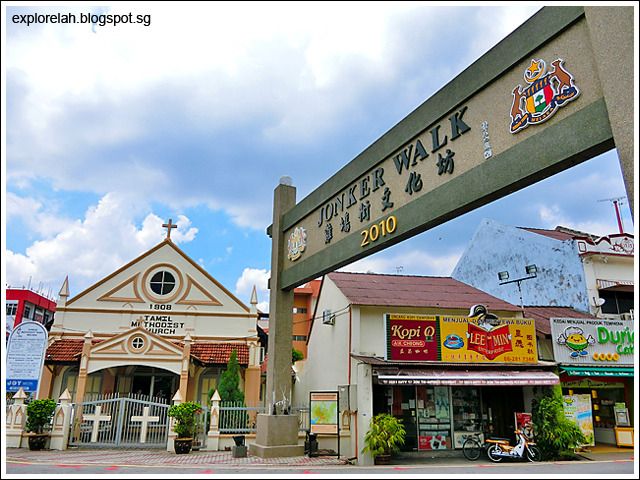
[Gateway to History & Gluttony] After an almost 4 hours coach ride from Singapore, we finally arrived in Malacca and began our photographic exploration at Jonker Walk, the city's antique street and mecca for local gastronomic delights.

[Sticky Brown Orgasm] It's almost a ritual whenever I visit Malacca that I must have a bowl of Cendol at the shop, Jonker 88. Look at that thick gula melaka (palm sugar) syrup caramelising the hump of shaved ice! My drool reached the floor. The laksa at the same shop is apparently quite good too.

[Eye Candy] My pupils put on weight just by looking at this rich and delicious dessert! Shot with Casio Exilim EX-ZR3500 Macro Mode.

[A Moment to Frame Time] Took this shot standing quite a distance away from the window as I wanted the old lady to be within the white grille yet not having too much loose space around her. If I brought my camera too close, the framed hole will become too big and cause excess space around the subject. So I stood further away and zoomed in.

Without a DSLR, this shot was quite a challenge to shoot and due to the low lighting within the house, the photo will be very grainy if shot with a mobile phone especially with a substantial zooming in to the subject. So I was pretty impressed with the result I got from Casio Exilim EX-ZR3500 that managed to capture depth-of-field like a DSLR by blurring the window grille and curtain, and maintain a generally smooth image despite the darkened interior.

[Brief Encounter] As I've visited Jonker Street / Walk before, I decided to venture off to the side alleys and parallel streets around that area to get under the skin of this historic precinct. But I didn't expect to get that under the skin. LOL.
[Paper Thin Temper] She's known as the Queen of Newspapers at Jonker and her temper is very fiery. Kena scolded for taking this shot.

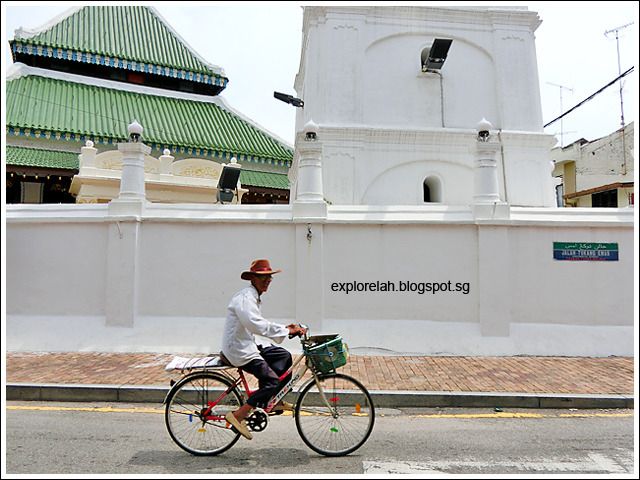
[Yesterday Once More] If this photo is in monochrome, it could very well look like a vintage shot with the old man cycling past the historic Kampung Kling Mosque. Completed in 1748, the mosque is located along Jalan Tukang Emas (Goldsmith Street), which is parallel to Jonker Street. Shot with Casio Exilim EX-ZR3500 Action Freeze Mode.

[House of Styles] Had wanted to enter the mosque during my previous trip to Malacca but it was closed. Thankfully it was open this time and I had a chance to be befuddled by the conglomerate of decorative influences that adorn the interior of this mosque. The exterior roof of the mosque is reminiscent of Hindu puras while Chinese motifs and European tile works and finishings filled the insides. This mosque is the most un-mosque I've seen and it's pretty cool.

[Un-mosque Mosque] A Victorian fountain in the washing courtyard of Kampung Kling Mosque. Shot with Casio Exilim EX-ZR3500 HDR Mode.

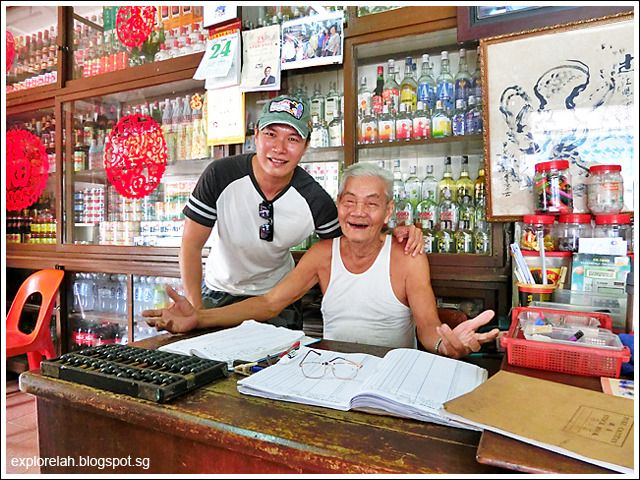
[Happy Uncle] A little walk from Kampung Kling Mosque, I came across a really old shop selling liquors. This grandpa was sitting in the shop hovering over his account books. The scene has such an authentic blast-to-the-past flavour that I started to take some photos of him at work while trying to block my presence behind some of his shop's merchandise.

But he looked up from his books at one point and discovered me sniping his photos. I thought he would scold me but he didn't. So I bought a bottle of drinking water from him and showed him his photos and we started to chat. He is such a jovial and happy soul! In the photo, he's pointing to his shop's original signage that has been around for more than 60 years!

[The Gula in the Melaka] 82yo Mr Tan is the second generation owner of the family-run business from his father who came from China. It used to be a provision shop but due to competition, the family decided to focus on selling liquors and alcoholic brews from Malaysian distilleries.

When I asked for a photo to be taken with him, he immediately struck such a natural and happy pose! It was really a great pleasure meeting him.

[Time Isn't a Debt] Mr Tan gladly showed me how he has done his accounts over all the years with his abacus. Many senior citizens treat getting old as a debt to be repaid to time but Mr Tan's cheerfulness and sprightly demeanour keep him young.

[Thy Will Be Done] Statue of Father Francis Xavier in front of St Paul's Church ruins. If you think something has happened that damaged the statue's right hand, well, there's more to the story...

Arriving in Malacca in 1545, the holyman is credited with spreading the gospel in Asia. He died in Malacca and was buried at the church temporarily but when his body was exhumed to be transported to Goa, they found that his body hasn't decayed! So the Pope asked for proof and one of Father Francis Xavier's hand was cut off. Legend has it that fresh blood flowed when his hand was severed. Father Francis Xavier was canonised in 1622 and this statue was installed in his memory in the 1980s but his hand went missing shortly. Perhaps his hand is still busy doing the work of God.

[Survivor] A lone seedling that grew where no other plants would grow. Saw this on a window frame of the St Paul's Church ruins and admired how the small tree broke through the hard stone and flourished. Shot with Casio Exilim EX-ZR3500 Black and White Mode.

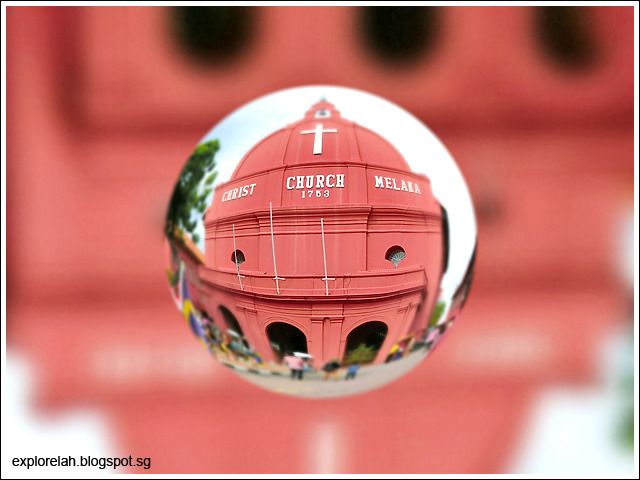
[A Different Perspective] Christ Church is possibly the most photographed icon of Malacca and here's a new way to shoot it... with Casio Exilim EX-ZR3500's Crystal Ball Mode! This mode is pretty fun to play with and the resulting images can have surprising results.

[Selfie So Easy] Did I mention taking selfies with the Casio Exilim EX-ZR3500 is addictive? :o)

Considered the cradle of Peranakan heritage, the UNESCO World Heritage listed Malacca is ever a treasure trove of historical finds and exquisite Nyonya cuisine. Having spent a weekend using the Casio Exilim EX-ZR3500 for street photography, I find the camera to be versatile and a good performer under various shooting conditions.

What's more, the camera comes with Wifi and Bluetooth connectivity so I can easily sync the photos I've shot to my phone and share them to my Facebook and Instagram. My only grouse is that the camera takes quite some time to process images when shooting with specialty modes but it's not a big bother for its stellar performance in most areas.

Although photos in this post have been processed with Photoshop to manage brightness, contrast and sharpness like I do for all photos I posted on this blog no matter what I shoot with, I find that adjustments to the Casio Exilim EX-ZR3500 are minimal. This is definitely a good companion for a holiday and a relief from carrying heavy DSLRs or stocking up on bricks of power banks to feed a hungry phone cam.

This post has been made possible by Casio Singapore.

13 April 2015

Johor - Ink Brew by JWC Cafe (墨跡手沖館) and Eh He Gallery

Date of Exploration : 24 Mar 2015

Retro flavoured kopitiams and eateries are plenty in Malaysia, where the good ol' days are still served up in good ol' ways, but a new breed of old-school coffeeshops are elevating nostalgia to the realm of designer vintage by turning the pleasure to reminisce into an artform. And paving the way is Ink Brew by JWC with the adjoining Eh He The Classic Accents Art House at Johor Bahru's heritage district of Tan Hiok Nee.

Discovering Ink Brew and Eh He was something of a beautiful serendipity. We were poking our noses into an oddstentatious (odd and ostentatious) shophouse facade at the mouth of Jalan Tan Hiok Nee, unsure of what to make of it when an uncle seated in a kopitiam opposite encouraged us to go in. As we stepped through the doors of Eh He, thinking it's a performance arts theatre, we soon realised it is actually an art gallery embalming the Chinese history of Johor Bahru (JB). Beyond the gallery is a door that links to Ink Brew where the founding spirit of the precinct is translated into the cafe's menu and its deco. The result is a kind of retro that exudes effortless authenticity and bespoke artistry to entice not just the palate but hold the senses spellbound.

Coffee with a story. Sipping a cuppa at Ink Brew is not just about the caffeine fix but appreciating the philosophy that went behind crafting the concoctions. This brew is called "游神 - 五帮共和" ("Parade of the Gods - Five Tribes Unified") and is made from 5 different coffee beans.

In the early days, 5 prominent ethnic groups from China settled in Johor Bahru. They are the Hokkiens, Hakkas, Teochews, Cantonese and Hainanese. As they hail from different sects, constant feuds and territory wars ensued, often with bloody consequences. To unify the fragmented dialect groups, the Parade of the Gods was created in JB so that the 5 groups may be unified through religion. As a homage to honour this history of JB, Ink Brew signatured this 5-beans-brew to remind drinkers that differences is the essence of a flavourful unified existence. RM15.00 (hot), RM16.50 (cold).
At first glance, Eh He and Ink Brew which opened in March 2015 may seem like just another business trying to milk the appeal of nostalgia but that's just the superficial. I had the good fortune of meeting Pauline, one of the establishment's owners, and got a behind-the-scene understanding of the thought processes that went into realising every aspect of the gallery and cafe's design, spatial planning, and curated heritage within the premises. I came in not knowing I had a thirst and left with a hunger fulfilled.

Getting to Eh He / Ink Brew

Eh He The Accents of Art gallery and Ink Brew by JWC can be accessed by different entrances but they are linked. Eh He's entrance is at the mouth of Jalan Tan Hiok Nee while Ink Brew's entrance faces Jalan Ibrahim. But the 2 are joined by a door on the second level so it doesn't matter which entrance you get in.

For the ease of explaining how to get here, I'll use the Jalan Tan Hiok Nee entrance of Eh He as a point to direct wayfinding. Jalan Tan Hiok Nee is a short historic street in Johor Bahru that's somewhat like Singapore's Haji Lane where pre-war shophouses occupied by avant garde fashion boutiques, restaurants, cafes and heritage businesses congregate to create a blast-from-the-past lifestyle destination within the city.

Entrance of Eh He The Classic Accents Art House gallery at the mouth of Jalan Tan Hiok Nee heritage street. Opposite Eh He's visage is Kin Wah kopitiam that serves up traditional Hainanese coffee and kampung chicken's soft-boiled eggs.
If you are coming from City Square shopping mall after clearing the Malaysian customs, look for the exit to Jalan Wong Ah Fook. Walk along Jalan Wong Ah Fook in the direction of the huge Hindu temple, Sri Raja Mariamman. Behind the temple is a street called Jalan Trus. Walk along Jalan Trus which leads down the city's unofficial Little India and towards JB Bazaar and you will come to the entrance of the Tan Hiok Nee Cultural Street. Eh He's entrance is facing the start of Tan Hiok Nee Cultural Street (photo above).

If you are unsure of your way, ask for directions to Sri Mariamman Hindu temple or Jalan Trus or Jalan Tan Hiok Nee along the street. Most locals would be able to point you in the right direction. It should take no more than 15 minutes to walk from City Square mall to Jalan Tan Hiok Nee at a leisurely pace.

Entrance of Ink Brew with the prominent Eh He frontage on Jalan Ibrahim. The shophouse that accommodates Eh He and Ink Brew is sandwiched between Jalan Tan Hiok Nee and Jalan Ibrahim.
Eh He The Classic Accents Art House

Eh He is an unconventional name for a gallery but there's a quirky rationale behind it. "Eh He" is derived from Earth Heart, meaning that art is all around us on this earth and also residing within us. If you look at Eh He's logo, you will also notice the words "中间" (middle) and "旁边" (to the side), which allude that art is at the heart of our being while at the same time, surrounding us.

In addition to "Eh He 中间\旁边", there's a red banner that reads (from right to left as in the way that olden Chinese texts are read) "吉安泰祥". For a moment I'm confused by the presence of so many phrases, making the sign seem more like a thesis rather a shop name. But after some explaning by the owner, I finally understood that 吉安 (ji an) is the name of the chief artist of Eh He gallery while 泰祥 (tai xiang) is the name of the business that used to occupy the shophouse.

Stepping through the entrance of Eh He is like stepping into a time machine. The first floor reception has 2 huge puppets and to the side is the original narrow stairs of the old shophouse that leads to the second level.

The second level of Eh He The Classic Accents Arts House. There's an old world charm about this place that's immediately captivating.

A photo on display at Eh He art gallery. The man in half wayang drag is 张吉安 (Zhang Ji An), a radio personality in Malaysia and artistic director of Eh He. Ji An did a series of photoshoots with his opera persona around different places in Johor as a reminder that where we are and where we are heading are rooted in our heritage and traditions. Modernity may have eroded the visibility of traditions but our distinct cultures live on.

There are listening stations around Eh He gallery where you can tune in to yesteryear operas and conversations spoken in the purest form of the various dialects in Johor Bahru decades ago. I love the retro transistor radios used for the listening stations that come with a USB port where you can just plug in a MP3 and play. It's an old shell with a new soul.

Surrounded by artistry in the gallery, we attempted to create our own photographic 'art'. Haha.

The best thing I like about Eh He gallery is the absence of "Do not touch" signs on its exhibits. There's no barrier to interact with the heritage artefacts to really feel them. But please handle with utmost care as many of these historic memorabilia are at the brink of falling apart.

刀马旦。Rekindling the days where I learnt and performed Chinese opera in my late teens. But mostly as a backdrop character. LOL. Behind me is the door that leads to Ink Brew by JWC cafe.
Ink Brew by JWC  (墨跡手沖館)

We almost didn't make it to Ink Brew by JWC which adjoins Eh He gallery through a door at the back of the art space. Initially, we thought the door was an access to the gallery's administrative office or staff quarters. But being nosy, we decided to check out where the door leads and thankfully we did. The door opens out to this...

... an unconventional sitting area that defies the usual set-up for a cafe. But I didn't think it was a cafe at first, and thought it's the make-up room for performance artistes who may put up shows at Eh He gallery.

But this is the extension of a sitting area for Ink Brew cafe. There's a lot of room to breathe here amongst salvaged vintage desks and authentic dressers that hail from the 70s. I immediately felt at home as one of my aunties used to have a wooden vanity dresser just like the one found here!

The walls surrounding the hall are the original structure of the old shophouses and you can see that some parts are not aligned in a straight line due to aging. The red calligraphic scroll encircling the ceiling is done by a renown calligrapher in Singapore as a gift to the cafe. And if you peer through the skylight, you will see a hump on the shophouse's roof that has been retained.

The hump is a classic Hainanese (I think) architectural feature that represents the mountain. In Chinese culture, having a house with a mountain at the back is good fengshui as it signifies that the household will have a solid backing in whatever it's inhabitants pursue.

Another door at the side of the sitting area above leads to a wholly different sitting space of Ink Brew with a stairway leading to the ground floor where the barista, cashier and kitchen reside.

Renovating the interior of the dilapidated shophouse took an arduous 4 months where many of the original building materials were retained.

The side wall of the cafe is exactly as it has been while as much of the original floor boards have been rescued and reuse. That explains the 2-colour tone of the wooden floor with the darker flooring being the original wood found in the shophouse and the lighter colour being add-ons because not all floorboards can be salvaged. I love how they try to recycle and 'artify' the old into the new.

Furniture at Ink Brew is also an inconsistent carpentry of tables and benches as they are made from salvaged wood at the original shophouse. What you are sitting on is a piece of Johor Bahru's history while you sip tea or coffee.

Here with Pauline See, the artist behind the massive wall mural at Ink Brew cafe. Her work behind us is titled "Temptation", which she alludes to how as children, we have ambitions and aspirations but as we grow up, we succumb to temptations that thwart the pursuit of our dreams.

She also shared that her artworks typically feature 3 colours - white to represent the aspirations and goodness that humanity possesses; black as a symbolic colour of the dark side or secrets that we don't want people to know; and red as the mark of breakthrough and creativity we have in us to make a difference.

What's not pictured here are flying whales near the roof which represent innovation, that we have the ability to break-free from our paradigms with courage and a readiness to adapt to new environments.

A staff sharing the stories and rationale behind the drinks and food items on the menu. I was so amazed by the casualness and enthusiasm of staff members taking the time to sit down and explain the concept behind the coffees, mocktails and food that they serve.

Drinking coffee at Ink Brew by JWC is an art of savouring the painstaking thought processes that went into creating the signature brews. Pictured here is 陈旭年咖啡 (Tan Hiok Nee Coffee). This cuppa is not created because the cafe sits on Jalan Tan Hiok Nee but a taste journey of the forefathers' effort to build Johor Bahru.

If you look at the Chinese word 旭 (xu4), it consists of the characters 九 (jiu3, nine) and 日(ri4, day). So the orange slice on the coffee has actually been sun dried for nine days. To truly enjoy this caffeine creation, you have to first put a bit of the cream in the mouth and drink the coffee. Then, take a bite of the orange slice and drink the coffee again. Lastly, submerge the remaining orange slice in the coffee, let it steep, and drink the brew again.

What you would taste is first bitterness, then an acidic sour flavour, followed by a sweet ending. This represents the 苦尽甘来 (joy after hard work) spirit of the early settlers where the virtue of being hardworking is rewarded with the fruits of the labour.

This story coffee doesn't come cheap though. It costs RM16.80 per cup.


Other than coffees, there are some taste innovations that are worth checking out. We love this mocktail called 小梦的天空 (Sky of a Little Girl, RM13.50) that features 泡泡糖 (crackling sweets). Every sip is a trip back to my childhood where these sweets crackle and come alive on my tongue! As the crackling sweets are kind of extinct on the streets, Ink Brew went through a lot of research to find a supplier.

Food is also on the serve. We ordered this pizza called The Garden (RM15.90) that has been designed by a nutritionist. It contains a lot of veggies on a thin pizza dough with the suace made from tofu. It's mild in taste but somehow you don't feel the guilt of gluttony.

I just had a bowl of curry noodles, 2 soft-boiled eggs, and a slice of banana sponge cake before eating this! So tam jiak because the items on Ink Brew's menu sounds so exotic.

We didn't plan on sitting down to have a coffee but the unusual vintage charm of Ink Brew compelled us to rest our feet with a step back into the past.

While prices aren't cheap at Ink Brew for the drinks, we find that Ink Brew and Eh He is totally worth checking out for the ambience, artistry, creativity and thoughtfulness that went into preserving this shophouse on Jalan Tan Hiok Nee and Johor Bahru's culture!

Related Posts Plugin for WordPress, Blogger...