Showing posts with label Nara Park. Show all posts

04 June 2016

Nara (Japan) - A Day Trip to Nara Park

Date of Exploration : 2 Apr 2016

When we planned a day trip to Nara Park, my intention of coming here was to see the park's famed tame deer. But at the end of my visit, I can't help but marvel at the buffet of experiences I had been served. The park has a unique and delicious mix of natural, cultural, and architectural flavours that few places in Japan, or anywhere else in the world can emulate.

Our excursion to Nara Park was part of the Osaka leg of my first trip to Japan's mainland, which also covered Tokyo and Kyoto. On the intended day of our Nara Park day trip, the weather in Osaka was rainy and gloomy so we checked the Japan MET forecast, saw that the following day was sunny in Nara, and decided to switch our plans to go Nara Park the next day. Boy were we glad we did. Visiting the park during a beautiful day of spring was sublimely splendid! So check the forecast before you visit and retain some flexibility in your itinerary to respond to the weather condition.

Getting to Nara Park (from Osaka)

Nara Park is at the centre of Nara City within Nara Prefecture and it is easily accessible from Kyoto or Osaka. The city of Kyoto, Nara and Osaka form sort of a triangle relative to each other with Nara in between the other two cities.

There are two main train services that link Kyoto and Osaka to Nara. One is the Japan Railways (JR) train and the other is the Kintetsu train. Where possible, choose the Kintetsu railway service as the station is located closer to Nara Park (about 10 minutes walk) while it takes around 20 minutes to walk to Nara Park from the JR Nara Station.

We stayed at Osaka's Namba district and there was a direct Kintetsu railway train to Nara. Ticket price was ¥560 (approx. S$7) and it took us about 40 minutes on the express route. It can be quite confusing when taking the rail services as the same route is served by different trains.

As a general rule, any train that goes the normal route will stop at every station between two points while "limited express" will stop at limited stops between the same two points.

Along the way, we sped past neat rows of low rise houses and buildings as well as fields that stretches towards the city nucleus.
We made the mistake of getting on a normal route train but thankfully we asked the other passengers on the train and a college youngster, though he spoke almost no English, did his best to get us to alight at the last stop that the limited express train would stop and board it. He did it by accompanying us to get off at the stop and pointing us to board the express train even though it was out of his way.

I was so impressed by his hospitality and very grateful because the express train skipped stopping at around 8 stations that the normal train would pick up passengers and that saved quite some travel time. The longest travel time on the limited express train between two stations without any stop is about 25 minutes so do go to the toilet before boarding.

Nature, Culture and Architecture

This post is a brief summation of my visit to Nara Park with an overview of what I encountered and experienced. Key attractions and activities at Nara Park include deer feeding, visiting Kasuga Taisha Shrine, Todaiji Temple, Kofukuji Temple, Nara National Museum and enjoying the lush gardens throughout the park. We didn't managed to cover everything and you can click on the highlighted links above of what we managed to do for more detailed information.

We left our hotel at about 10am to go to Nara Park and ended the visit at about 5pm so plan for a full day trip and go even earlier than us in order to see everything at the park.

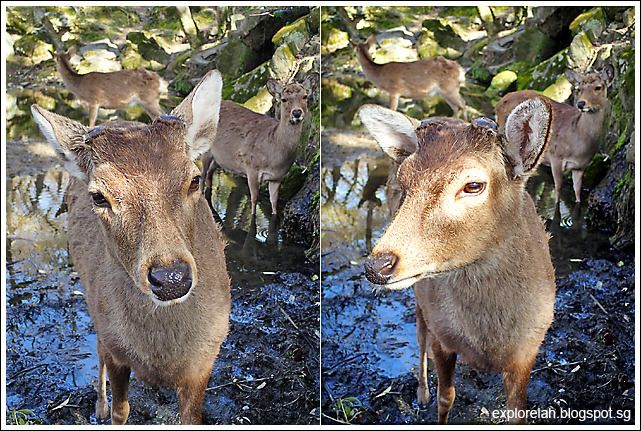
The first thing that made my heart skip were the free roaming deer we came across as we got closer to one of the entrances of Nara Park. I didn't expect to see a deer so soon and thought it would be a matter of luck to see them but no, they were everywhere! And if you bought their favourite snack (shika sembei deer biscuit) from one of the street vendors, you won't be left alone.

You don't have to look for the deer at Nara Park. They look for you if you have their addiction on hand... their favourite biscuit - shika sembei. It is okay to feed, pet and get close to the deer but keep in mind that they are wild beasts, abet accustomed to humans, so have an eye out for aggressive behaviour and avoid those that are intrusive.

吵架了。Looks like they had a quarrel and are not seeing eye-to-eye. Well, in any relationship that is close, it is inevitable that each others' coat get ruffled once in a while. It is a test of the strength of the union and the depth of letting-go-ness. Strong ones will grow stronger through the trials, and the unstable ones will snap.
Some beg, others snatch, but most would bow to be fed. Click here to learn the trick of feeding the Nara Park deer.
This scene looks like one of those drawings I made in my childhood years as part of those psychological assessments that predict your personality based on where you placed elements such as tree, river, house, mountain, sun, etc.
The first site of historical importance we came to was Kofukuji Temple. It adjoins a five-tiered pagoda that was built in 730 and has become an unofficial symbol of Nara.
A museum (not the Nara National Museum) that we passed by while on our way to Kasuga Taisha Shrine.

The middle gate (chumon) of Kasuga Taisha, which is a Shinto shrine and stands out from other shrines because of its...

... countless stone and bronze lanterns that decorate and surround the shrine grounds. Read more about Kasuga Taisha here.
From Kasuga Taisha, we walked over to Todaiji Temple, one of Japan's most historically and culturally significant places of worship.
The attraction at Todaiji, and it's hard to miss, is the giant Buddha. Read more about Todaiji here.

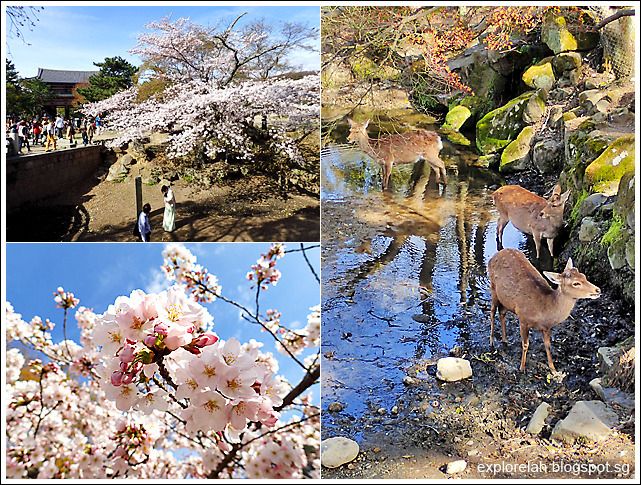
Nara Park consists of many gardens and parks that offer rewarding sights during different seasons. We came during the beginning of spring marked by the blossoming of sakuras and an explosion of pink blanketed the Kasugano-enchi Park near Todaiji Temple.

Upclose with one of the yaezakura (cherry blossoms with flowers that have more than 5 petals) species.
The roof poking out from the trees is that of Todaiji Temple. We ended our excursion to Nara Park at Kasugano-enchi Park. The sun was beginning to set and painted the far sky with crimson hues. Surrounding the park were sakuras in full bloom and a wide expanse of grassy field in front of us. I didn't think the scene was particularly captivating, but it was beautiful because of the company I had to see it with.

Related Posts :
Deer Moments at Nara Park
Kasuga Taisha Shrine of Lanterns
Todaiji : The Great Eastern Temple of Shingon Buddhism

14 May 2016

Nara (Japan) - Todaiji : The Great Eastern Temple of Shingon Buddhism
Date of Exploration : 2 Apr 2016

Ranked amongst one of Japan's most important historical landmarks and a major Buddhist temple in the country, Todaiji (東大寺 Great Eastern Temple) is an attraction that matches the nation's religious devotion in scale and presence.

We almost skipped a pop over to this crowning jewel of Nara because we underestimated the time we would spend with Nara Park's deer and at Kasuga Taisha Shrine, the famous Shinto shrine of lanterns. But thankfully, we made it and were glad we didn't let a non-visit become that thing we regret not doing during a trip. 

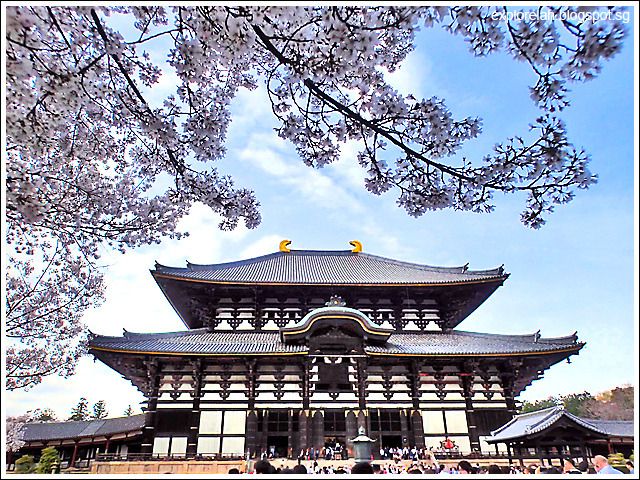
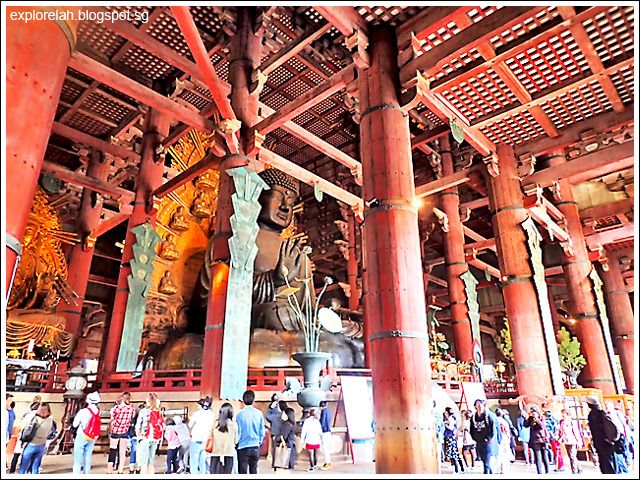
Todaiji's Big Buddha Hall (daibutsuden) is the largest wooden building in the world.

The temple has an understated magnificence that is both commanding yet humble at the same time. It is grand beyond any doubt. But it is also inviting, unassuming, and rather serene despite the throngs of people visiting the sacred site.

Getting to Todaiji - Look Out for Deer by the Water

We came to Todaiji after visiting Kasuga Taisha Shrine by following signposts that pointed the way. The two religious attractions are not too far apart and took us only about 15 minutes to walk between them.

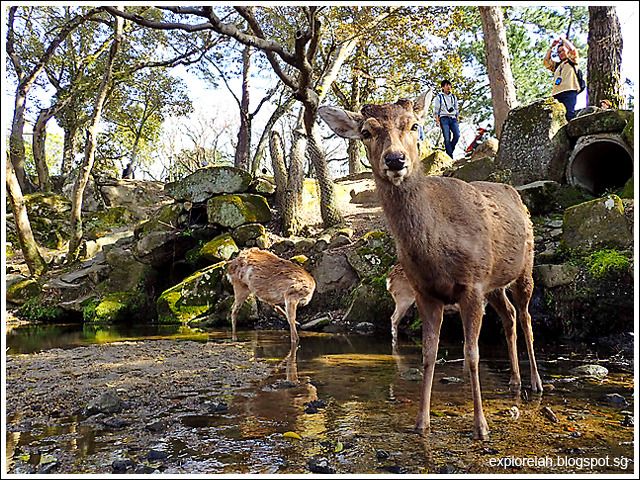
On the path leading to Todaiji's Great South Gate (Nandai-mon), we crossed a bridge over what looked like a dried up pond and in it were... deer! We've already taken many, many deer photos since we set foot in Nara but we just cannot tahan not photographing them at every change of scene we see them in.

Synchronised head turning. As I was shooting the deer in front, I realised that the deer behind synchronises its gaze with the front one. When the front one looks at me, the back one looks too and when the front looks to one side, so does the back deer. Is this adorable or creepy? LOL.

We fell into the "deer trap" again and spent quite some time here photographing them although Todaiji was nearing its closing time. Fortunately, we managed to stop the deer from hijacking our cameras anymore and managed to explore Todaiji.
Todaiji's Nandai-Mon (東大寺南大门)

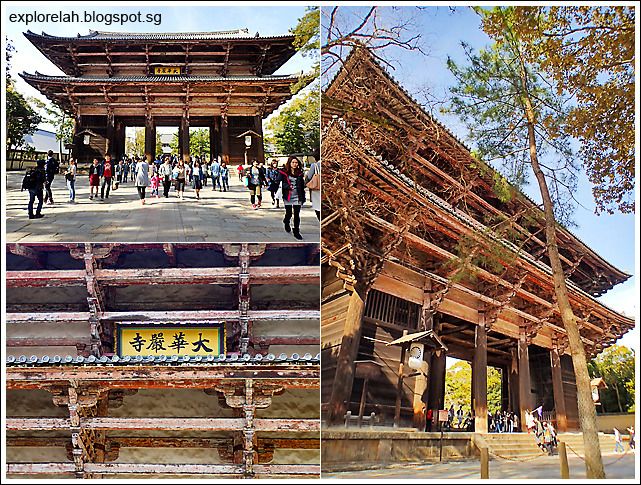
Completed in 1203, the Nandai-mon or Great South Gate has architectural influences from China's Sung Dynasty and is the largest temple gate entrance in Japan. This is the Godzilla of Japanese gates.

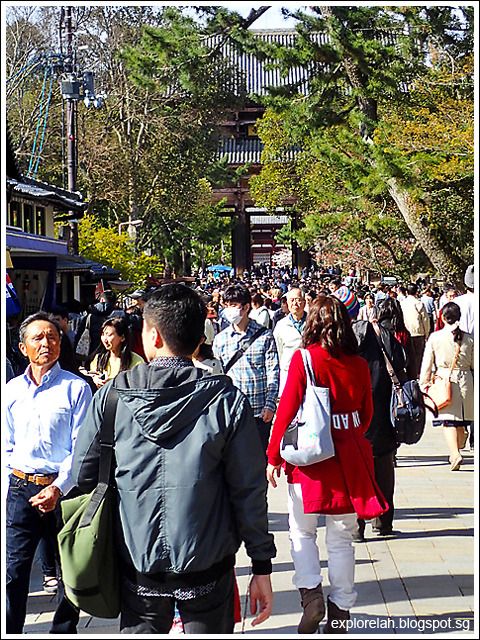
The amount of foot traffic to Todaiji was crazy during our visit which coincided with sakura season.

Made entirely out of wood, the original Nandai-mon was destroyed in a typhoon and the current day's structure is a rebuilt version dating back to the 12th century.

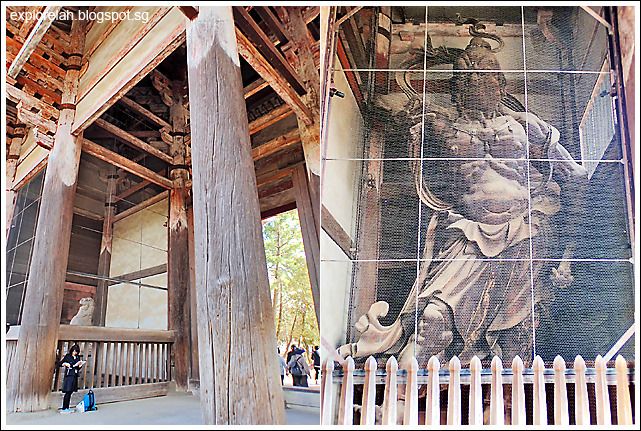
Over 25m tall, the south gate has 18 massive pillars that come from single trunks of trees. Two colossal guardian deities each standing at 8.4m height are found on each side. Known as the two kings of Todaiji, the duo is part of the Four Heavenly Kings (四大天王) who guard the four cardinal points. The other two are found inside Todaiji's Main Buddha Hall.
Picturesque Todaiji

I find it fascinating to see how Buddhism is translated into a plethora of architectural styles... from the colourful and ornate jian nian (cut-paste 剪粘) roofings characteristic of China's Chinese temples to the all-seeing eye hallmark of Tibetan temples to the flambouyant gold-gilded wats of Indochine (Thailand, Laos, Myanmar) surrounded by a proliferation of stupas (with the exception of Cambodia's favour for sandstone) to Japan's colour-subdued, minimalist zen approach to temple buildings.
 
The compounds of Todaiji have a lot of space and an understated beauty that when paired with the season's flourishing sakura blooms, make for postcard-perfect photographs to relish a visit with.

Passing through Nandai-mon, we came to yet another gate where entrance tickets to Todaiji are sold (¥500 per entry for adults).

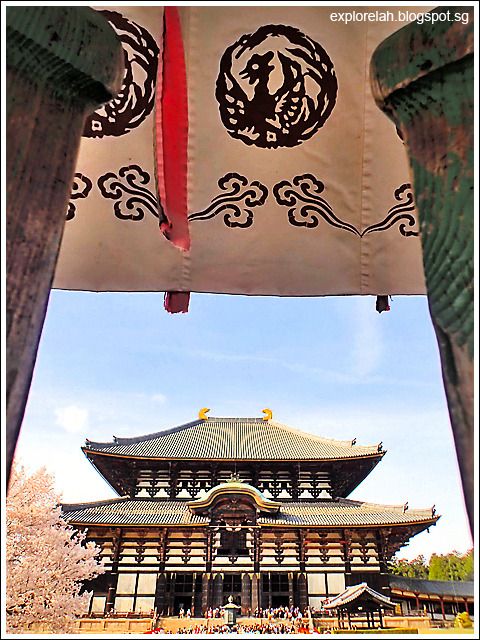
And finally we got to lay eyes on Todaiji with the sakuras in bloom! The temple compound is very neat and picturesque.

Framing Todaiji with the weeping fuchsia variety of sakura.

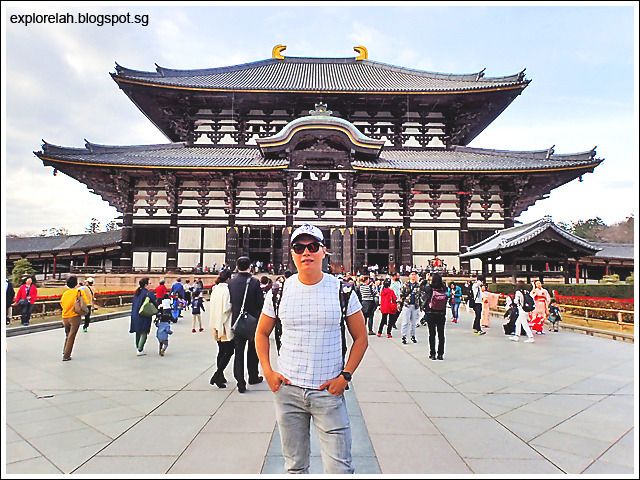
That essential "I'm here" shot :o) The thing that's as big as the temple is my expanding waistline from all that feasting on Japanese donburis (rice bowl dishes) and ramens (noodles).

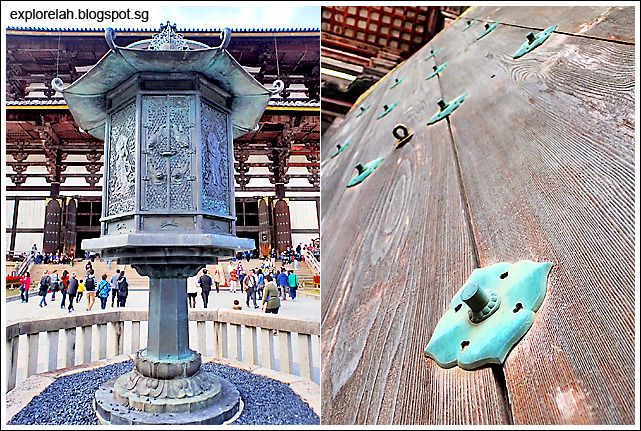
A intricately carved octagonal bronze lantern greeted us as we got nearer to the temple and I got a closer look at the motifs that adorn the prayer hall's entrance doors.

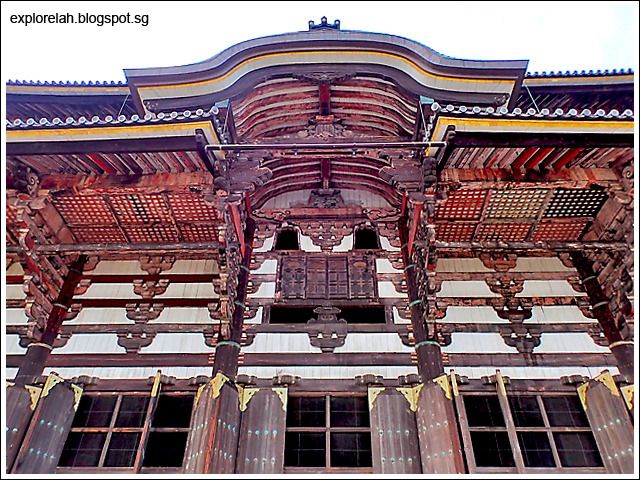
Upper facade of Todaiji Temple.
House of Giants

Small is not in the vocabulary of Todaiji as everything about it is larger-than-life. Huge gates, big entrances, towering pillars, and gigantic statues... instead of making me feel small, it's as if the temple made me a bigger person just from trying to contain the sight of its sheer size.

Beyond the main prayer hall's entrance door, a collection of massive sacred statues that hold significant cultural as well as historical significance await tourists and devotees. But before entering Todaiji, check out the temple's version of Little Red Riding Hood...

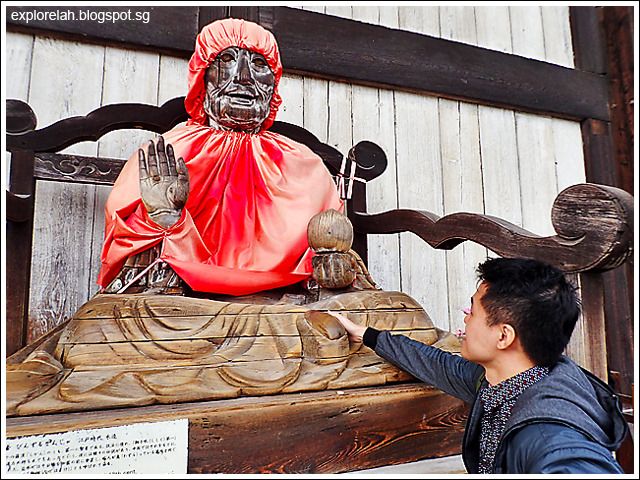
To the right of the temple is an 18th century wooden statue of Binzuru (Pindola Bharadvaja), one of the 4 arhats (enlightened disciples, much like the saints of Christianity) that Buddha requested to stay on earth to spread Buddhism.

Binzuru is a master of mystical powers and the Japanese believes that if you touch a part of Binzuru and subsequently rub your hands on a corresponding part of your body, you will receive healing of ailments affecting that body part. As the statue is elevated, the only parts that can be touched are the lower limbs region. Too bad if you're suffering from asthma or headaches.

Just for fun, I touched the foot of Binzuru like the guy in the photo and touched both my feet as I've been suffering from plantar fasciitis, which is the pain that stretches the length of the sole for many months, and guess what? My condition improved tremendously after I returned from the trip! I'm a skeptic when it comes to such religious healing stuff and I've clean forgotten about this touching ritual I performed until I write this blog post and remembered what I've done and made that connection about the improvement in my condition. Then again, it could be that my condition was already on its way of getting better and it was just a coincidence that I followed the ritual (for the fun of assimilating myself as a local) even though I didn't believe in it.

Sharing this anecdote, I'm not advocating that the ritual works, but just musing about the forgotten correlation. If there is even one at all.
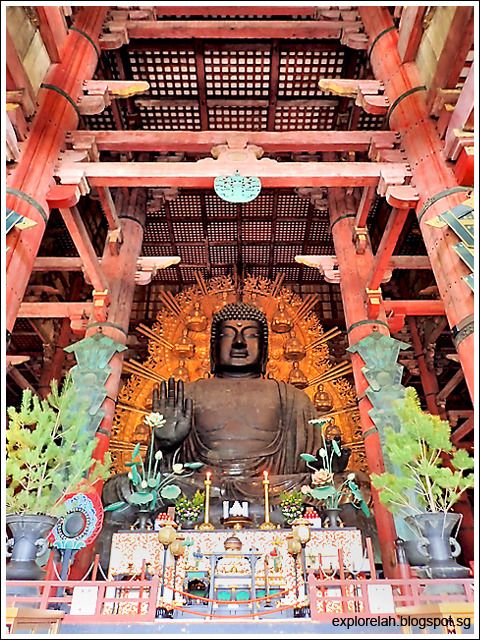
Om... This  Main altar of Todaiji with a 15m tall giant Buddha (Daibutsu) that is one of the biggest in Japan.

Every time I visit a Buddhist temple in a different Asian region or country, a distinct style of architecture and decoration is apparent although some elements such as the lotus motif is common. Even though we believe in different gods / prophets, the message of love, compassion, tolerance and peaceful coexistence is common.

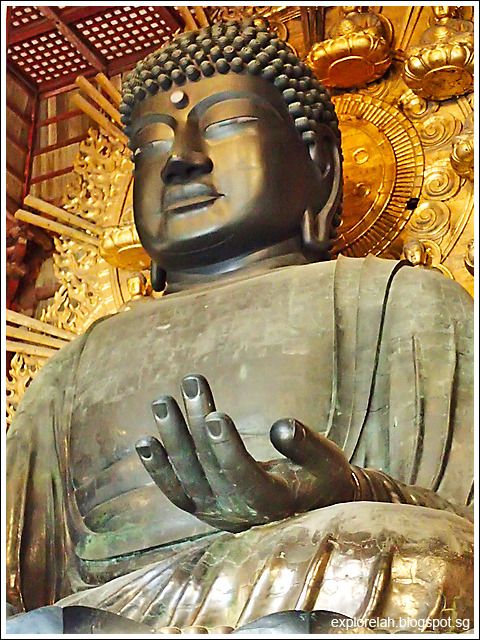
The giant Buddha was completed in 752 and went through several rounds of restoration, once when its head fell off during a major earthquake in 855. The last restoration works were done in 1185 (body) and 1692 (head). The statue is designated a UNESCO World Heritage Site Historic Monuments of Ancient Nara and a National Treasure.

To one side of the giant Buddha is a gilded statue of Kokūzō Bosatsu, the Bodhisattva of wisdom and memory... I sure need lots of these two qualities!

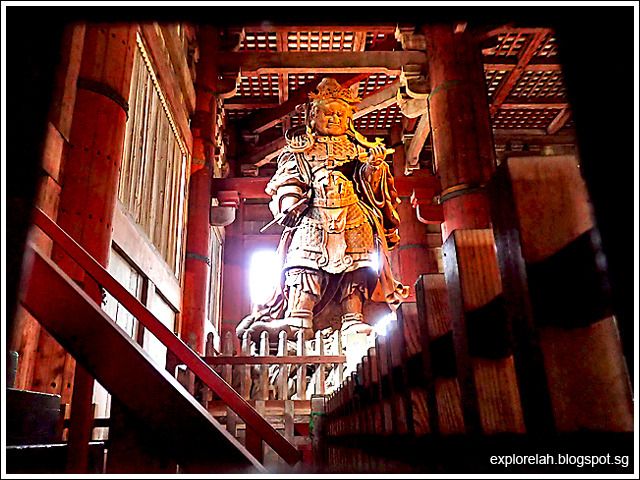
In the temple are the remaining two of the Four Heavenly Kings who guard the four cardinal points. This one is Komoku-ten, king of the west and lord of limitless vision who can see through evil.

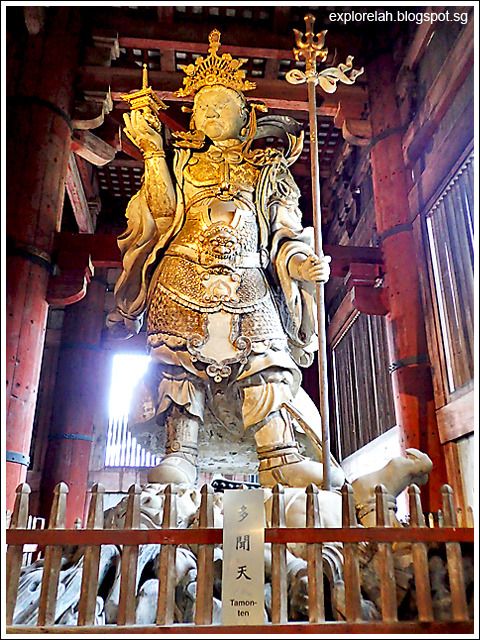
The other Heavenly King in Todaiji is Tamon-ten, king of the north and the lord who hears all.

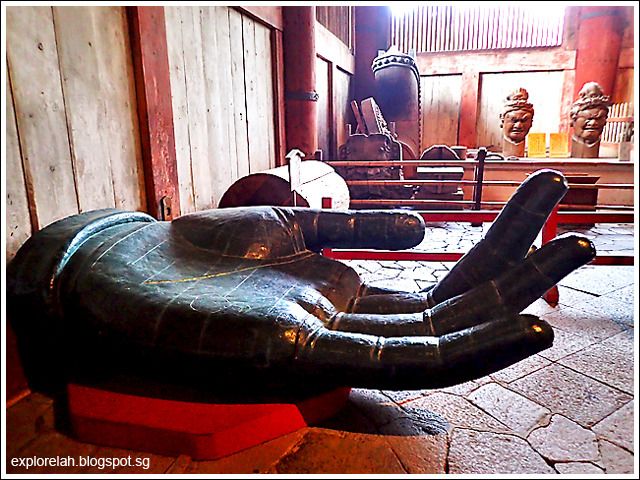
Do you need a helping hand with life's problems?

Or give those problems the middle finger and carry on!

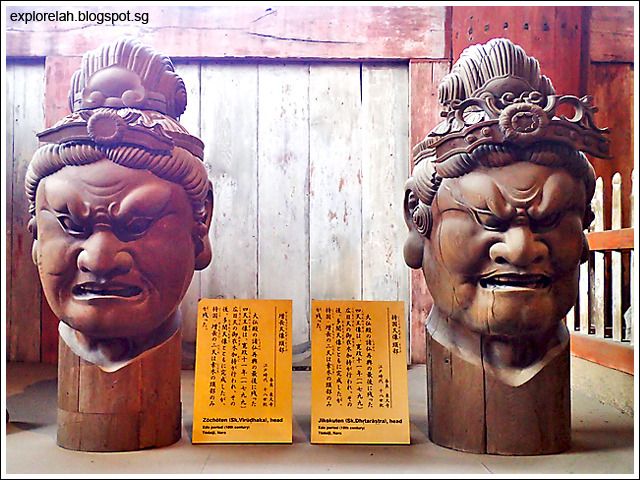
Bas-relief of Zocho-ten (king of the south, lord of spiritual growth) on the left and right is that of Jikoku-ten (king of the east, guardian of the nation).
Do You Want to Attain Enlightenment?

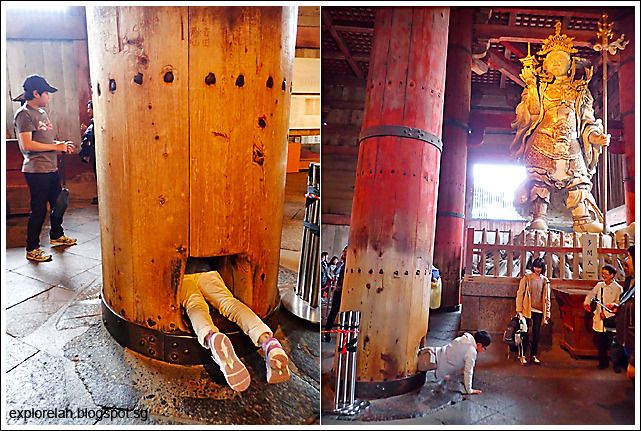
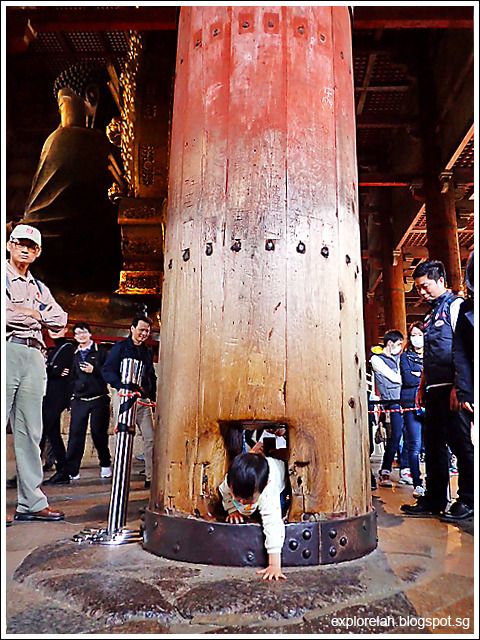
From the towering proportions of Todaiji's religious statues, we now shrink our attention to a hole at the base of one of the pillars in front of the Tamon-ten image.

The hole is the size of Daibutsu's nostril and it is said that if you can squeeze yourself through one side and come out the other side, you will be able to attain enlightenment in your next life. So if you want to attain enlightenment, pretend you're a thread trying to pass through the eye of a needle!

Squeezing through the hole is a very popular activity in Todaiji and there's a long queue to try being Buddha's booger. I didn't put myself through it because the hole can obviously fit only small children and very, very petite adults.

Or it can act as a measuring device to determine if it's time to lose weight. If you can pass through, you are fine, but if you stuck, it's a heavenly sign to give up char kway teow!

But I think the hole is a measure for innocence and purity, for only the pure of heart can attain enlightenment. So my interpretation of this activity is that... in order to be "enlightened", we must first cultivate our hearts and thoughts so that they are innocent and pure like that of a child.
I'm Christian by upbringing and faith so this passing-through-a-hole thing reminded me of a verse in the Gospel of Luke [18:25] where Jesus said : "Indeed, it is easier for a camel to pass through an eye of a needle than for a rich man to enter the kingdom of God." This sentiment is also reflected in the Islamic Quran [Verse 7:40] and Jewish sentiments as a metaphor to anything that is impossible...

UNLESS

... "Therefore, whoever humbles himself like this little child is the greatest in the kingdom of heaven." Gospel of Matthew [18:4].

I see a similarity across religions despite the differences in the definitions of who/what is god. It is not easy to get into heaven or achieve enlightenment. It takes humility, not hostility. It requires compassion for fellow humankind, not destruction of innocent lives.

Whoops... there I go again rambling about the interpretations of things I saw instead of providing more useful visitation information about Todaiji. Please pardon me. This Japan trip had been very special for me and I wanted to recount and reminisce every bit of it as a way of reliving, and then recovering from, the depth of my love and filing it as a beautiful memory. If only there's a god to pray the heartbreak away.

Related Posts :

Kasuga Taisha Shrine of Lanterns

Deer Moments at Nara Park

08 May 2016

Nara (Japan) - Kasuga Taisha Shrine of Lanterns

Date of Exploration : 2 Apr 2016

It wasn't easy to break free from the adorable deer of Nara Park but when we finally managed to break free from their disarming cuteness through restraint from taking any more photos of them, we finally made our way to Kasuga Taisha (Kasuga Grand Shrine 春日大社).

A key attraction in Nara City, Kasuga Taisha Shrine is famous for the thousands of stone and bronze lanterns that crowd its vicinity as well as within its walls. The number of lanterns I came across was truly bewildering!

Through its countless lanterns, Kasuga Taisha Shrine shines as one of Japan's most unique devotional expression of Shintoism.

Established in 768AD, the shrine has been recognised as a UNESCO World Heritage Site since 1998 and stands today as a living architectural record of the period where Japan began to move out of the shadow of China.

Getting Here - Follow the Path of the Stone Lanterns

Getting to Kasuga Taisha Shrine takes about 30 minutes on foot cutting across Nara Park from the Kintetsu Nara Station. However, our journey took triple the time because we fell under the charms of the park's free ranging deer, stopping often to snap photos and buying special deer biscuits to feed them.

It also took us a bit of asking around to get on the right path to the shrine because while there maps around the park, there weren't many signposts to point the way. Or perhaps we missed the signages because we were constantly distracted by scouting for photo opportunities with the deer. The way to Kasuga Taisha Shrine is pretty straightforward and we knew were on the right path when we started spotting the shrine's iconic stone lanterns.


Follow the path of the stone lanterns that line a rustic trail leading to Kasuga Taisha Shrine.
More deers along the way milling in and out of the forest and stone lanterns. When you come to a split road, take the path on the right to reach the front entrance of Kasuga Taisha Shrine. The path on the left is for people who are leaving the shrine.
I told myself no more deer photos but couldn't help shooting more as the scenery changes from Nara Park's forested setting to the ancient frame of Kasuga Taisha Shrine's stone lanterns to lens the deer in. This buck poking its head out amongst the stone columns is so kawaii hor? :o)

Entering the Realm of the Kamis

Kasuga Taisha is a Shinto shrine that is dedicated to four minor folk spirits / deities (kami in Japanese) :

Takemikazuchi-no-mikoto (god of thunder) - Also known as Kashima-no-kami, he is often depicted as subduing a giant catfish that causes earthquakes
Futsunushi-no-mikoto (spirit of swords) - Priests performing rituals and rites typically bear a Nihonto sword

Amenokoyane-no-mikoto (ancestor of the Nakatomi clan) - He is the protector deity of the clan and a guardian appointed by the goddess Amaterasu omikami to guard a divine mirror; and he is enshrined with a Himegami (female consort deity)

* The suffix "-no-mikoto" is an honourary title given to a spirit or venerated person that connotes 'winged being'

The crimson arch (torii) marks the perimeters of the shrine and the path (sandō) leading to Kasuga Taisha Shrine's main entrance gate. The number of stone lanterns intensifies as you get closer to the entrance gate. As my visit coincided with the sakura season, an explosion of pink blooms cascaded over a section of the stone lanterns next to the entrance gate. So pretty!
An assembly of stone lanterns fringes the entrance gate of Kasuga Taisha Shrine with a glorious pink sakura tree punctuating the scene beautifully.
While it's free to browse around the area in front of the offering hall just after the entrance gate, a fee of ¥500 is collected for entry into the inner prayer halls. We were curious about the inside so we paid the fee at the counter where a deer spirit boy extends his hand out as if asking for money. There are also wooden cards, some shaped as the head of a deer, that can be purchased to write wishes on and hung at the shrine.
Inside the shrine's compound, hanging bronze lanterns took over from the stone ones. This is the chumon (middle gate) flanked by oro (roofed veranda) that guards the shrine's main sanctuary which houses the shrines of the 4 kamis.
Framing the chumon with a pair of stone lanterns that are more ornate than the ones seen outside the shrine.
We could walk around the veranda corridors that surround the main sanctuary but entry into the sanctuary is not allowed and so we didn't get to see the classical Nara architecture of the 4 spirit houses.
There are approximately 3,000 lanterns in and around the shrine and they are lit twice a year... once in early February, and another in mid August. This angle can be shot at the free zone without having to pay to go in.

Where do the lanterns come from? They are donated by devotees.
Nobody lights a lantern to see the sun.
If I wore green, I could be that superhero who charges up his power with lanterns!

If you can't wait till February or August to see the lanterns lighted up, there's a dark room towards the back where you see what they look like when lit.

The lantern needs the candlelight to shine, or it'll just be an empty shell; and the candle needs the lantern to protect it or it might get blown out. The candlelight is like the soul and the lantern is the body. Our soul gives purpose our body and we must keep our body strong to allow the soul to keep shining. Cheem boh? LOL.

There are actually a lot more things to see around Kasuga Taisha Shrine. There is the Kasuga Taisha Shinen Manyo Botanical Garden, a Treasure House and 12 shrines along a path outside the southern side of the main shrine complex. The shrines that are dedicated to 12 gods of luck. Looks like Lady Luck no longer needs to work alone now. 

Among the shrines is the Meoto Daikokusha shrine, which is the only shrine in Japan dedicated to married deities. In other words, this is a love shrine for those who want to pray for a good match or for a blissful marriage. Too bad we didn't get to visit. If we did, maybe we wouldn't have become me.

For opening hours, fees and more information, do visit the two links below that I found very helpful :

Kasuga Taisha Official Site
Japan-Guide.com Kasuga Taisha

Related Posts :

Deer Moments at Nara Park

Todaiji : The Great Eastern Temple of Shingon Buddhism
Related Posts Plugin for WordPress, Blogger...