Showing posts with label Buddhism. Show all posts

14 May 2016

Nara (Japan) - Todaiji : The Great Eastern Temple of Shingon Buddhism

Date of Exploration : 2 Apr 2016

Ranked amongst one of Japan's most important historical landmarks and a major Buddhist temple in the country, Todaiji (東大寺 Great Eastern Temple) is an attraction that matches the nation's religious devotion in scale and presence.

We almost skipped a pop over to this crowning jewel of Nara because we underestimated the time we would spend with Nara Park's deer and at Kasuga Taisha Shrine, the famous Shinto shrine of lanterns. But thankfully, we made it and were glad we didn't let a non-visit become that thing we regret not doing during a trip. 
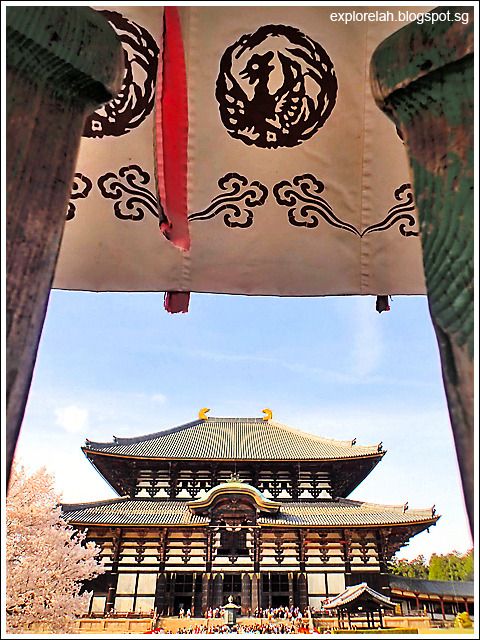
Todaiji's Big Buddha Hall (daibutsuden) is the largest wooden building in the world.

The temple has an understated magnificence that is both commanding yet humble at the same time. It is grand beyond any doubt. But it is also inviting, unassuming, and rather serene despite the throngs of people visiting the sacred site.

Getting to Todaiji - Look Out for Deer by the Water

We came to Todaiji after visiting Kasuga Taisha Shrine by following signposts that pointed the way. The two religious attractions are not too far apart and took us only about 15 minutes to walk between them.
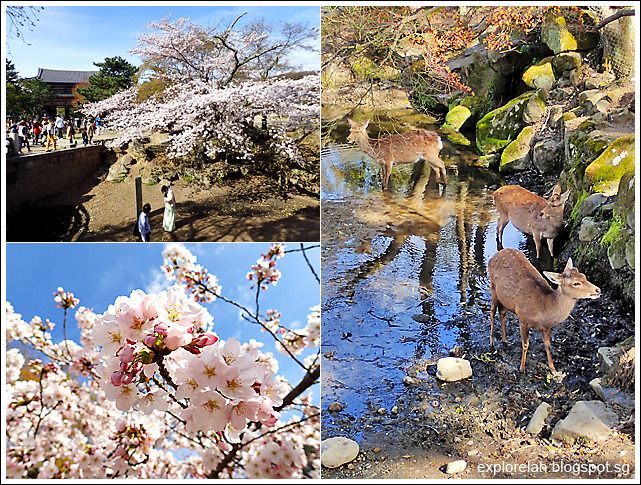
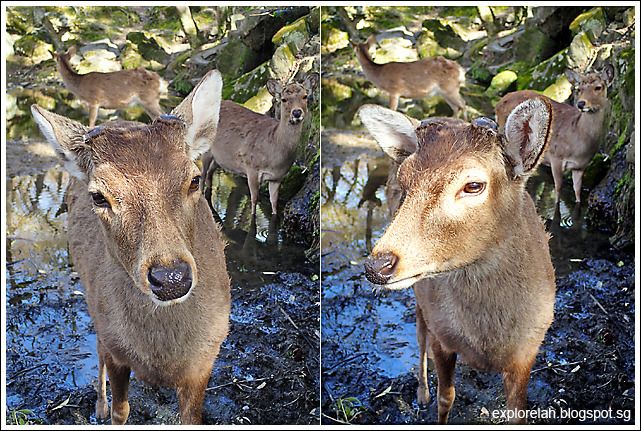
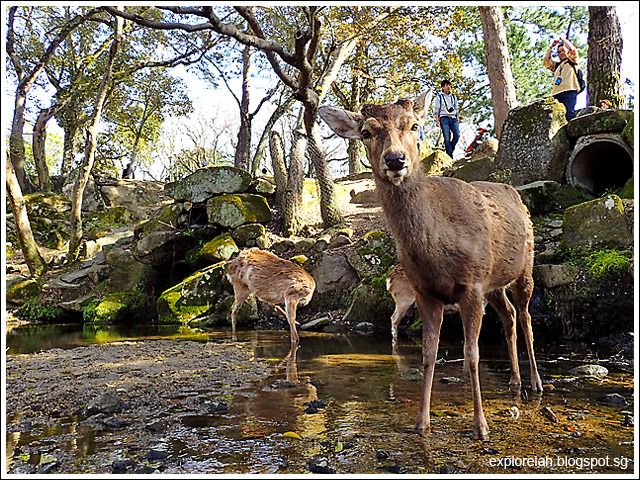
On the path leading to Todaiji's Great South Gate (Nandai-mon), we crossed a bridge over what looked like a dried up pond and in it were... deer! We've already taken many, many deer photos since we set foot in Nara but we just cannot tahan not photographing them at every change of scene we see them in.

Synchronised head turning. As I was shooting the deer in front, I realised that the deer behind synchronises its gaze with the front one. When the front one looks at me, the back one looks too and when the front looks to one side, so does the back deer. Is this adorable or creepy? LOL.

We fell into the "deer trap" again and spent quite some time here photographing them although Todaiji was nearing its closing time. Fortunately, we managed to stop the deer from hijacking our cameras anymore and managed to explore Todaiji.
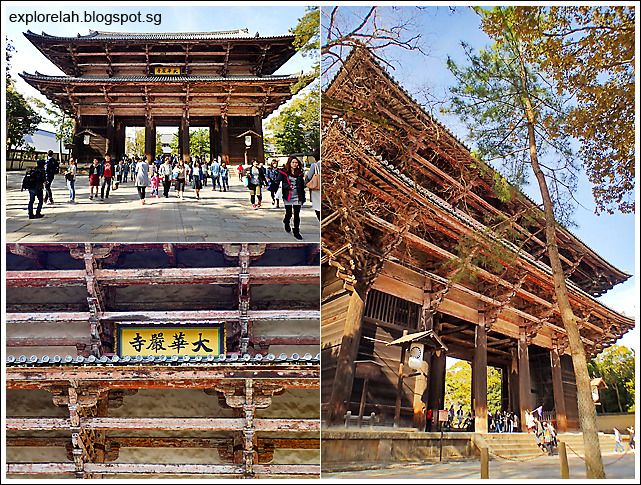
Todaiji's Nandai-Mon (東大寺南大门)

Completed in 1203, the Nandai-mon or Great South Gate has architectural influences from China's Sung Dynasty and is the largest temple gate entrance in Japan. This is the Godzilla of Japanese gates.
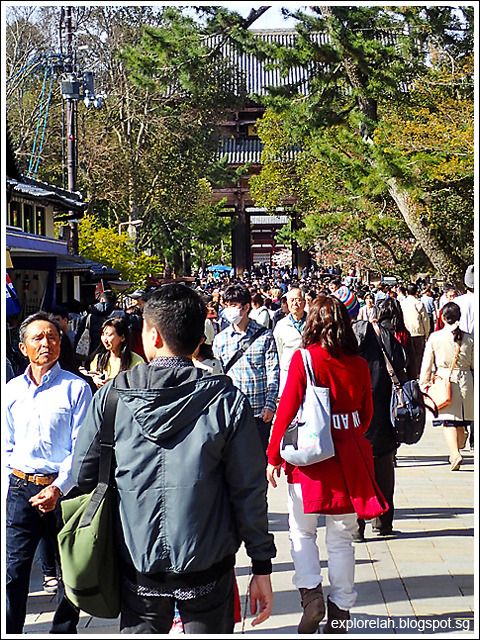
The amount of foot traffic to Todaiji was crazy during our visit which coincided with sakura season.

Made entirely out of wood, the original Nandai-mon was destroyed in a typhoon and the current day's structure is a rebuilt version dating back to the 12th century.

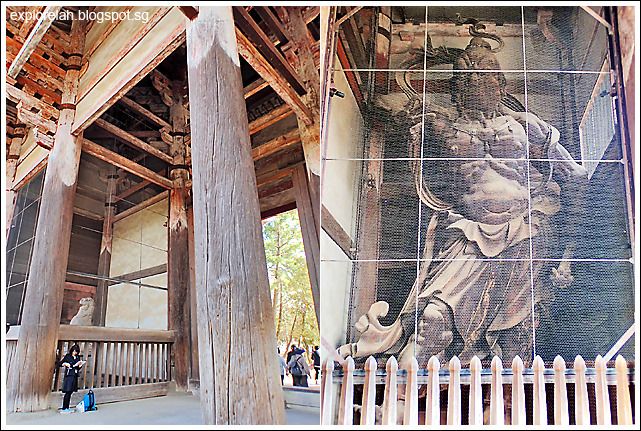
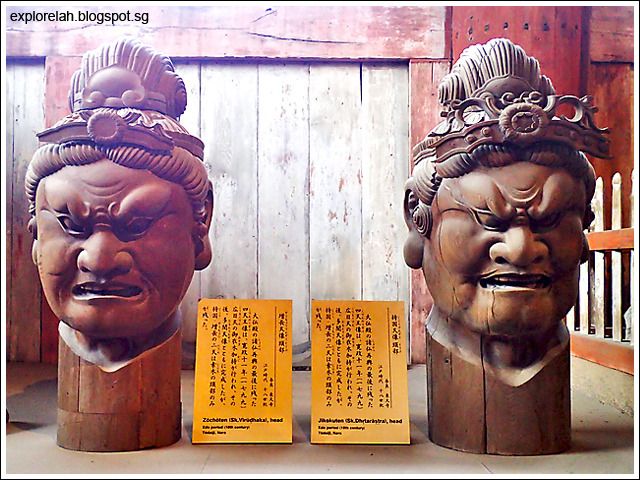
Over 25m tall, the south gate has 18 massive pillars that come from single trunks of trees. Two colossal guardian deities each standing at 8.4m height are found on each side. Known as the two kings of Todaiji, the duo is part of the Four Heavenly Kings (四大天王) who guard the four cardinal points. The other two are found inside Todaiji's Main Buddha Hall.
Picturesque Todaiji

I find it fascinating to see how Buddhism is translated into a plethora of architectural styles... from the colourful and ornate jian nian (cut-paste 剪粘) roofings characteristic of China's Chinese temples to the all-seeing eye hallmark of Tibetan temples to the flambouyant gold-gilded wats of Indochine (Thailand, Laos, Myanmar) surrounded by a proliferation of stupas (with the exception of Cambodia's favour for sandstone) to Japan's colour-subdued, minimalist zen approach to temple buildings.
 
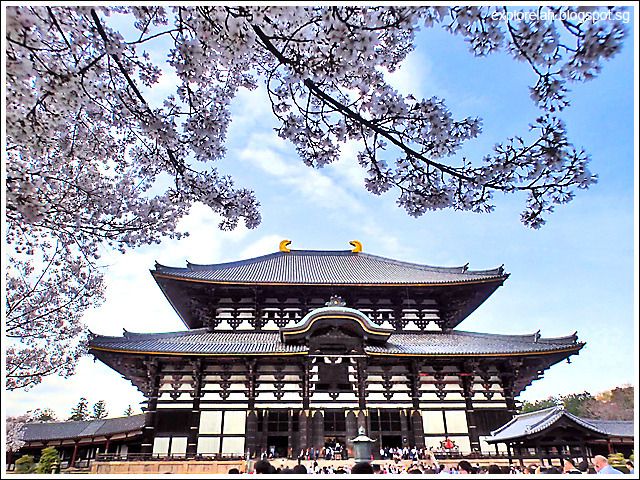
The compounds of Todaiji have a lot of space and an understated beauty that when paired with the season's flourishing sakura blooms, make for postcard-perfect photographs to relish a visit with.

Passing through Nandai-mon, we came to yet another gate where entrance tickets to Todaiji are sold (¥500 per entry for adults).

And finally we got to lay eyes on Todaiji with the sakuras in bloom! The temple compound is very neat and picturesque.

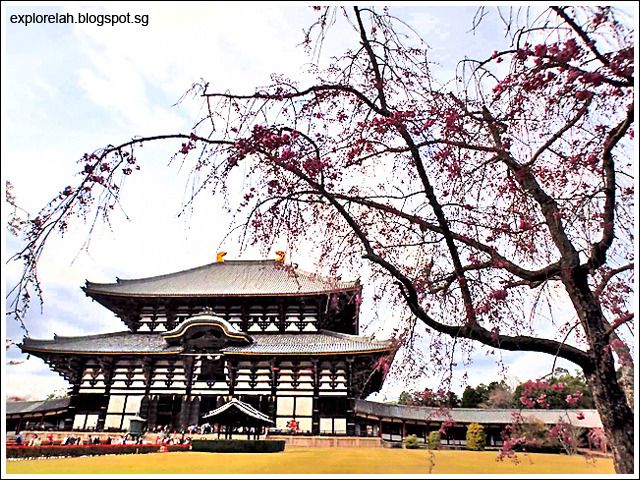
Framing Todaiji with the weeping fuchsia variety of sakura.

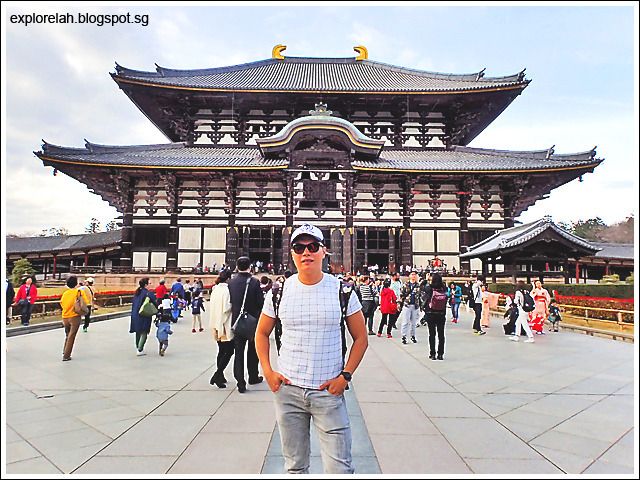
That essential "I'm here" shot :o) The thing that's as big as the temple is my expanding waistline from all that feasting on Japanese donburis (rice bowl dishes) and ramens (noodles).

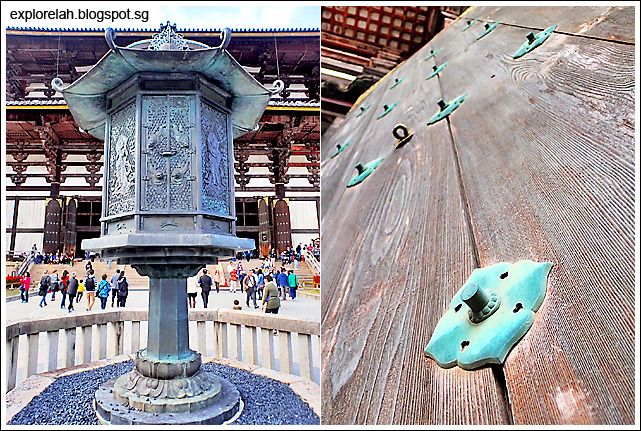
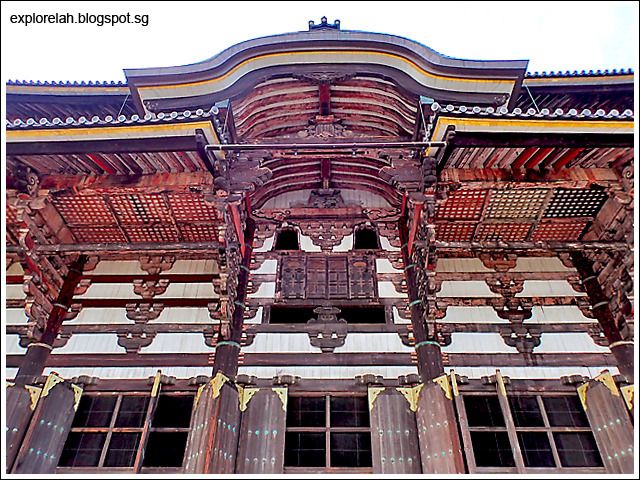
A intricately carved octagonal bronze lantern greeted us as we got nearer to the temple and I got a closer look at the motifs that adorn the prayer hall's entrance doors.

Upper facade of Todaiji Temple.
House of Giants

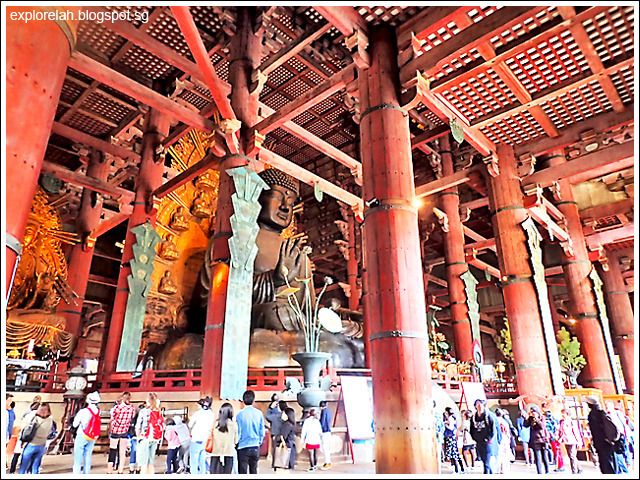
Small is not in the vocabulary of Todaiji as everything about it is larger-than-life. Huge gates, big entrances, towering pillars, and gigantic statues... instead of making me feel small, it's as if the temple made me a bigger person just from trying to contain the sight of its sheer size.

Beyond the main prayer hall's entrance door, a collection of massive sacred statues that hold significant cultural as well as historical significance await tourists and devotees. But before entering Todaiji, check out the temple's version of Little Red Riding Hood...
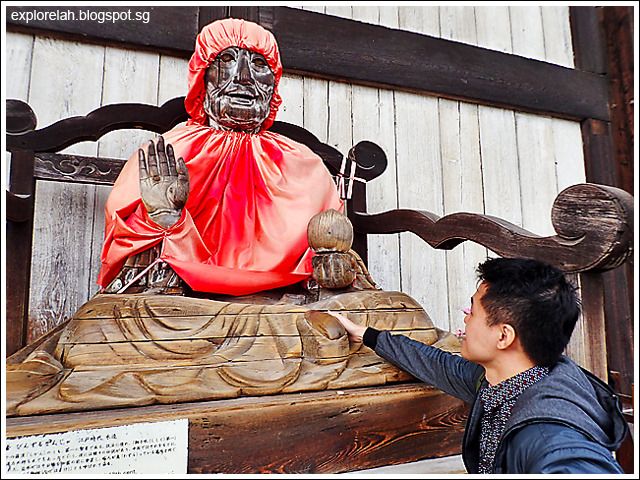
To the right of the temple is an 18th century wooden statue of Binzuru (Pindola Bharadvaja), one of the 4 arhats (enlightened disciples, much like the saints of Christianity) that Buddha requested to stay on earth to spread Buddhism.

Binzuru is a master of mystical powers and the Japanese believes that if you touch a part of Binzuru and subsequently rub your hands on a corresponding part of your body, you will receive healing of ailments affecting that body part. As the statue is elevated, the only parts that can be touched are the lower limbs region. Too bad if you're suffering from asthma or headaches.

Just for fun, I touched the foot of Binzuru like the guy in the photo and touched both my feet as I've been suffering from plantar fasciitis, which is the pain that stretches the length of the sole for many months, and guess what? My condition improved tremendously after I returned from the trip! I'm a skeptic when it comes to such religious healing stuff and I've clean forgotten about this touching ritual I performed until I write this blog post and remembered what I've done and made that connection about the improvement in my condition. Then again, it could be that my condition was already on its way of getting better and it was just a coincidence that I followed the ritual (for the fun of assimilating myself as a local) even though I didn't believe in it.

Sharing this anecdote, I'm not advocating that the ritual works, but just musing about the forgotten correlation. If there is even one at all.
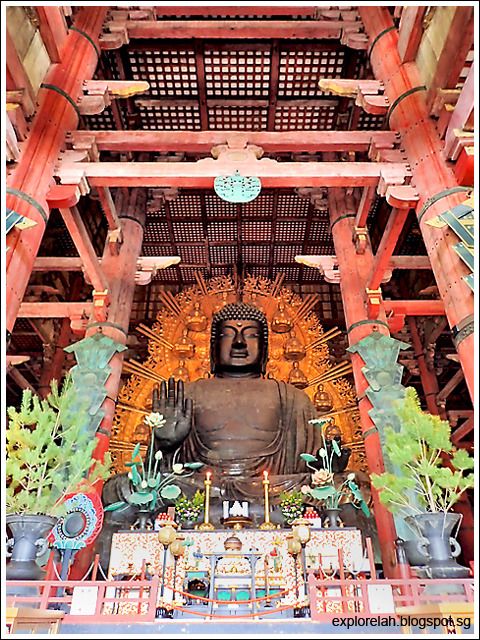
Om... This  Main altar of Todaiji with a 15m tall giant Buddha (Daibutsu) that is one of the biggest in Japan.

Every time I visit a Buddhist temple in a different Asian region or country, a distinct style of architecture and decoration is apparent although some elements such as the lotus motif is common. Even though we believe in different gods / prophets, the message of love, compassion, tolerance and peaceful coexistence is common.

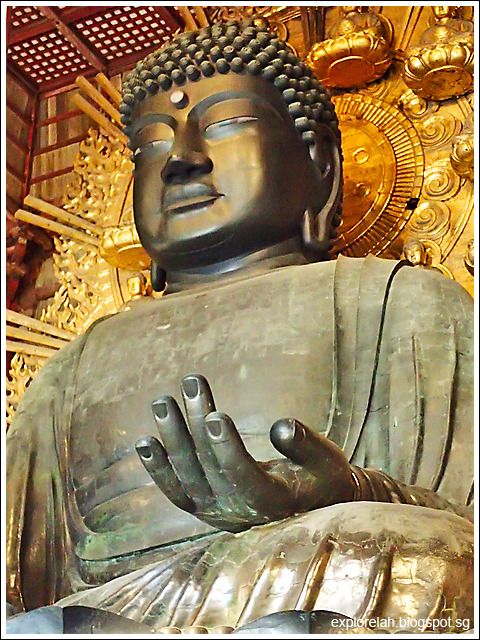
The giant Buddha was completed in 752 and went through several rounds of restoration, once when its head fell off during a major earthquake in 855. The last restoration works were done in 1185 (body) and 1692 (head). The statue is designated a UNESCO World Heritage Site Historic Monuments of Ancient Nara and a National Treasure.

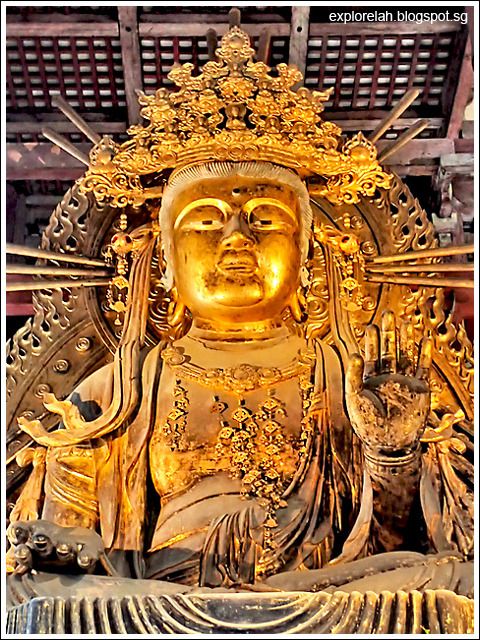
To one side of the giant Buddha is a gilded statue of Kokūzō Bosatsu, the Bodhisattva of wisdom and memory... I sure need lots of these two qualities!

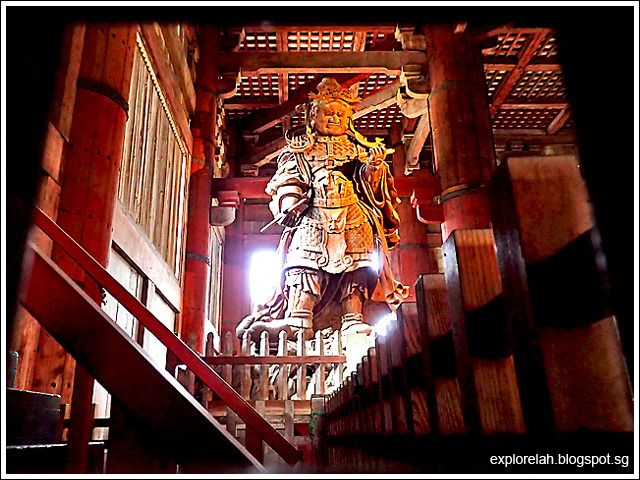
In the temple are the remaining two of the Four Heavenly Kings who guard the four cardinal points. This one is Komoku-ten, king of the west and lord of limitless vision who can see through evil.

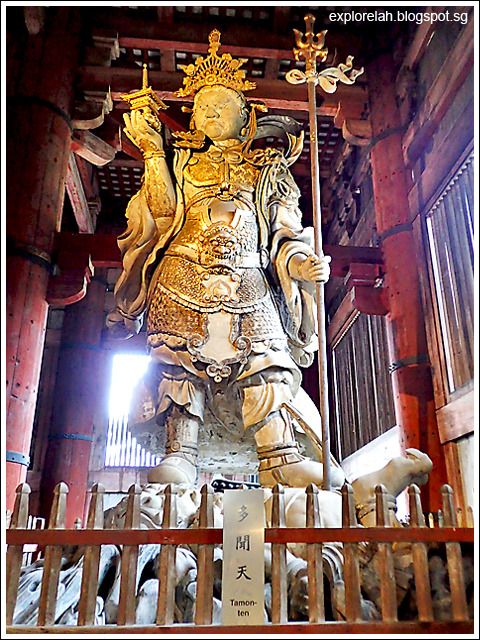
The other Heavenly King in Todaiji is Tamon-ten, king of the north and the lord who hears all.

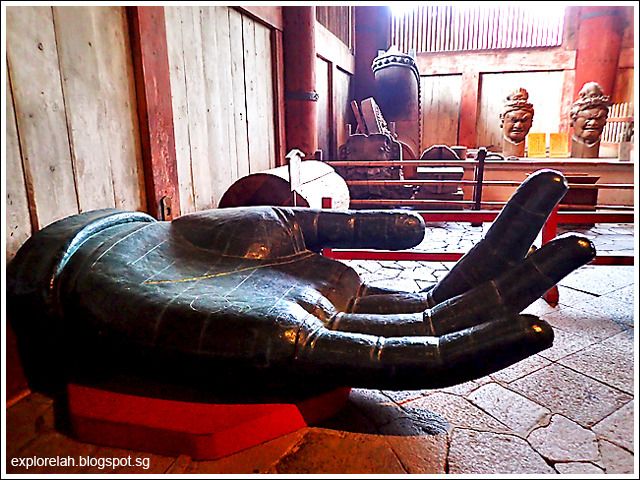
Do you need a helping hand with life's problems?

Or give those problems the middle finger and carry on!

Bas-relief of Zocho-ten (king of the south, lord of spiritual growth) on the left and right is that of Jikoku-ten (king of the east, guardian of the nation).
Do You Want to Attain Enlightenment?

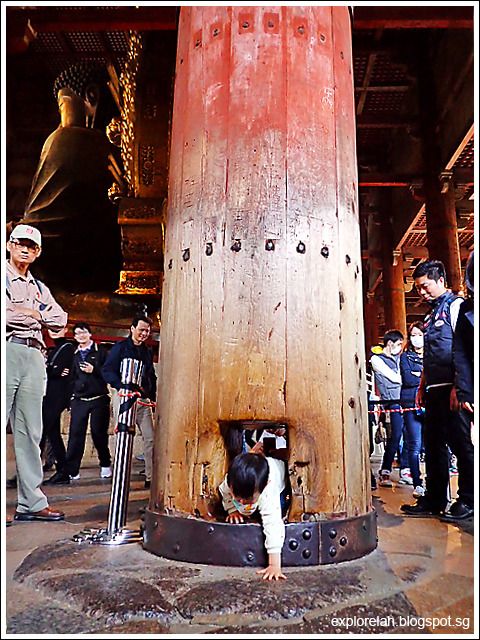
From the towering proportions of Todaiji's religious statues, we now shrink our attention to a hole at the base of one of the pillars in front of the Tamon-ten image.

The hole is the size of Daibutsu's nostril and it is said that if you can squeeze yourself through one side and come out the other side, you will be able to attain enlightenment in your next life. So if you want to attain enlightenment, pretend you're a thread trying to pass through the eye of a needle!
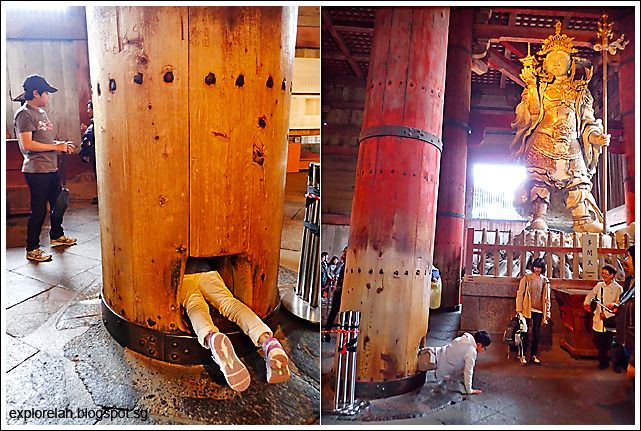
Squeezing through the hole is a very popular activity in Todaiji and there's a long queue to try being Buddha's booger. I didn't put myself through it because the hole can obviously fit only small children and very, very petite adults.

Or it can act as a measuring device to determine if it's time to lose weight. If you can pass through, you are fine, but if you stuck, it's a heavenly sign to give up char kway teow!

But I think the hole is a measure for innocence and purity, for only the pure of heart can attain enlightenment. So my interpretation of this activity is that... in order to be "enlightened", we must first cultivate our hearts and thoughts so that they are innocent and pure like that of a child.
I'm Christian by upbringing and faith so this passing-through-a-hole thing reminded me of a verse in the Gospel of Luke [18:25] where Jesus said : "Indeed, it is easier for a camel to pass through an eye of a needle than for a rich man to enter the kingdom of God." This sentiment is also reflected in the Islamic Quran [Verse 7:40] and Jewish sentiments as a metaphor to anything that is impossible...

UNLESS

... "Therefore, whoever humbles himself like this little child is the greatest in the kingdom of heaven." Gospel of Matthew [18:4].

I see a similarity across religions despite the differences in the definitions of who/what is god. It is not easy to get into heaven or achieve enlightenment. It takes humility, not hostility. It requires compassion for fellow humankind, not destruction of innocent lives.

Whoops... there I go again rambling about the interpretations of things I saw instead of providing more useful visitation information about Todaiji. Please pardon me. This Japan trip had been very special for me and I wanted to recount and reminisce every bit of it as a way of reliving, and then recovering from, the depth of my love and filing it as a beautiful memory. If only there's a god to pray the heartbreak away.

Related Posts :

Kasuga Taisha Shrine of Lanterns

Deer Moments at Nara Park
07 April 2014

Krabi - Wat Sai Thai

Date of Exploration : 12 Jan 2014

Blink, and we almost missed it. Wat Sai Thai wasn't on our Krabi itinerary but having passed it a couple of times on our way to Krabi Town from Ao Nang Beach, we decided to check it out since we had a free day. I was so glad I dropped by.

Sitting at the foot of a limestone boulder, Wat Sai Thai is more of a huge shrine than a proper temple. It plays a central role during Buddhist festivals and weddings where locals would gather.

A 15m tall reclining Buddha is the obvious draw for Wat Sai Thai. But to me, the main attraction were something else. Read on to find out what they are.

Digging for information about Wat Sai Thai would put Sherlock Holmes out of business because it doesn't have much of an online presence. The temple is almost as invisible on the net as it is in guidebooks.

View of the temple grounds in front of the reclining Buddha. Apart from a shelter housing the Buddha, Wat Sai Thai is pretty naked. No ornate decorations typical of Thai temples here, but in my opinion, I think less is definitely more in adding a raw flavour to this religious site. It's a refreshing break from the majority of flambouyant wats in Thailand.

Nature overruns Wat Sai Thai.

A modest ubosot (prayer hall) and presumably future ho rakang (bell tower) at Wat Sai Thai. A shell museum of sorts was also under construction to recognise the site's archaeological significance to Krabi's formation and natural history.

I was wandering around taking photos of the temple when an elderly monk approached me. I had no idea what he was saying most of the time but through some miracle of my broken Thai and body gesturing, the kindly old man led us to discover more of Wat Sai Thai.

I had no idea what this crevice is but I assume it is a resting place for religious idols because I found these lining the shallow cave...

From figurines of the king (?) to headless religious statues, the idol 'grave' intrigued and unsettled me.

Moving past the hole in the limestone stump, I was led to a courtyard of impressive trees. The most impressive of all was this stunning giant...

I'm not sure I got it right, but according to the monk, this tree is more than a century old! This colossal tree is an attraction all unto itself at Wat Sai Thai.

As the temple was not developed as a tourist attraction, we could climb up and get upclose with the majestic tree. Watch your step while climbing though as there isn't a paved way leading up and the hardened earth the roots held on to are ready to drink blood.

The encounter with the forest giant was phenomenal. The old monk left us and we continued to explore Wat Sai Thai on our own. If you are facing the huge reclining Buddha, a pathway to the left leads to the massive tree while a path on the right leads to the monks' quarters. As we approached, a couple of dogs barked incessantly. They seemed hostile.

But a monk emerged from his lodge and spoke to the brown-coated dog. I think he told it to show us around. Because what followed next really blew my mind away!

The brown dog showed us around! It would walk ahead of us and look back often to see if we are following. It brought us to a rubber plantation at the temple's backyard. I found this spirit house at the entrance to the plantation peculiar for 2 reasons... first, it is made of stone (they are usually made of wood) and secondly, it is on the ground. Spirit houses traditionally sit on a pedestal.

Our four-legged guide pointed us to his playground.

My new furry friend. This dog made my visit to Wat Sai Thai that much more magical! He is definitely an attraction at the temple. I saw online that there were other visitors who had the privilege of this yellow dog's company. Wished I had some yum-yums to thank him with. If you visit the temple, bring along some doggy treats!

Our canine guide hard at work showing us the way up the side of Wat Sai Thai to some hillside pavilions, tombs and chedis.

Mid-way up Wat Sai Thai. At this point, our yellow friend went further up and deeper into the hill's foliage but we didn't follow as we weren't dressed for serious trekking.

On our way down from the hill, we spotted this peculiar coiled shell.It looked really, really old!

Was tempted to bag this highly unusual shell that looks like a curled up worm home but decided to just bring home photos. Take nothing from nature except images. A monk also gave May, our gungho explorer, three blessed stones, one for each of us but we returned them to the land from whence they came.

Unexpectedly, I spent almost 2 hours at Wat Sai Thai, much to the chagrin of my companions. I was captivated by the 'natureness' and unexpected discoveries of this rare Thai temple and its furry guide. Here we are waiting for a songtheaw back to our hotel along Ao Nang Beach.

Getting to Wat Sai Thai isn't difficult as the locals know this temple. You can either get a cab here and have it wait for you (approximately 400 baht) or take a songtheaw (20 - 30 baht one way per person).

We took the songtheaw option and while there were many prowling Ao Nang Beach where we boarded from, none can be seen along the highway where Wat Sai Thai sits. We were a little worried about not getting transport back but after a 15-minutes wait opposite the temple, a songtheaw came along and ferried us back to Ao Nang Beach.

Wat Sai Thai is one of those temples that doesn't seem like much on the surface but when you get under its skin, you get the kind of pictures that belong in the heart and not in the camera.

Related Posts :

Shrine in the Sky : Krabi's Tiger Cave Temple

The Immaculate Wat Kaewkorawaram

06 April 2014

Shrine in the Sky : Krabi's Tiger Cave Temple

Date of Exploration : 13 Jan 2014

Whenever I think about what makes Thailand unique, two things come to mind... ladyboys and Buddhist temples. However, while the ladyboys can look as different as Cinderella and Godzilla, temples seem to differentiate little. There are few temples ('wat' in Thai) that truly stand out from the crowd and Krabi's Tiger Cave Temple is one of those that would leave a deep impression. And I'm not kidding when I say it is heads above the rest! 

Tiger Cave Temple (Wat Tham Suea) is named for the tiger paw prints found in a cave within a complex system of caves in the vicinity. Another explanation for the name stems from a monk who had a vision of tigers roaming the area while meditating in the cave. Today, the tiger cave is an inner sanctum used by monks for meditation.

Regardless of the name's origin, I had an instant connection with temple because I'm born in the year of the Tiger.
My visit to the temple was part of a packaged land tour that included splash time at a hot spring and the Emerald Pool, two of Krabi's top natural attractions.

We purchased the package off one of the many tour booths that lined the Ao Nang Beach boulevard. The asking price was 900baht but we bargained to 750baht for the full-day tour that covered the three sights. Prices may change depending on tourist season so be prepared that they can be vastly different.

Always shop around and check the prices of a few booths before deciding on one. There's also a substantial price difference if you choose to tour with a large group of 30 or a small group of 12. We went for the 12 people in a mini van option.

Entrance to Tiger Cave Temple. No tigers around but the litter of commando-trained monkeys can be equally fearsome. Avoid wearing loose jewellery and secure your bags and cameras when visiting. These critters have fast hands.
A Guanyin shrine within the temple grounds.

I thought the concept of an open-faced pagoda to house the Goddess of Mercy statue rather innovative visually.
Time to Climb

I didn't get to explore every corner of Tiger Cave Temple because as you know, following a guided tour, time is usually limited. From what I've seen, Tiger Cave Temple seem to be made up of a collection of outdoor, indoor and cave shrines scattered throughout the holy site.

We were given 1.5 hours here by our tour guide who was more interested in finishing his job than ensuring we had a good time. Side story... during our drive to the hot spring, my 'chocolate eclair' factory had a delivery and requested for a stopover at a gas station along the way. The stop was made but our guide made sure I felt guilty for requesting a toilet break during the 80 minutes' drive throughout the trip. In all my travels, I've yet to meet a tour guide who made me feel so terrible for answering nature's call.

Heaven this way...
Other than the alleged tiger paw prints in a cave which we didn't get to see, the key attraction here is a butt-busting climb to a mountaintop shrine which has...

Get a good cardio workout while sightseeing... why not?!

Every thousand mile journey starts with one step. Every 1,237-step climb starts with a wish for longer legs to get to the summit sooner!

Here we go... YES! NO! Just climb LA!

It's such a freaking looooooooong waaaaaaaay up...

... he was a young man when he started the climb.

Finally, after quite a few breaks to rest and catch our breaths, we reached the final flight to the summit. A certain level of fitness is definitely required if you want to attempt the climbing feat.

But as long as you don't give up, you will reach the top! All of us made it after about 30 minutes of not quitting. Success! You can go topless during the climb to avoid soaking the tee but do remember to get dressed before approaching the shrine.

View of Krabi from the top of Tiger Cave Temple.

Taking in the mountain majesty.

A shrine with a gigantic Buddha statue sits about 2,000 feet above the base of the climb.

Shrine in the sky... some men trip over pebbles of life's troubles, yet others moved stones to build the impossible. I guess the long way up is a lesson of faith in oneself to reach our goal.


Instant nirvana... if not from these personification of calm, it's from the adrenalin overdose brought on by the challenging climb.

The blockbuster at the top is a 278m tall golden Buddha statue.

Wat Tham Suea subscribes to Vipassana Buddhism, a Buddhist tradition that focuses on gaining an insight into the true nature of reality through meditation. 

The 3 percepts key to the Vipassana school is the impermanence of life, suffering as a result of being dissatisfied with conditions of existence, and the notion of non-self (the illusion of self in one's possession, and spiritual freedom is achieved by not clinging to these worldly materialism).

Mystery of the weeping Buddha... From afar, the massive statue looks normal. But a zoomed in shot of the face revealed what seem like tear trails below the eyes. A case of 'Don't Cry for Me Bodhisattva'? I wonder what caused the stains of sorrow down his face.

When we took up the tour package for the Hot Spring > Emerald Pool > Tiger Cave Temple day trip, I wasn't quite keen on the religious leg of the journey as I felt I've seen enough of Thai temples in my years of exploring Thailand. But this temple was literally the high point in admiring the devotion of a nation and appreciating yet another manifestation of the country's faithful.

If it's not to behold the giant Buddha on a mountaintop or the aerial view of Krabi at the summit, Tiger Cave Temple is a must-visit to test the limits of your cardiovascular health!

Related Post :

Krabi Hot Spring & Emerald Pool

Wat Sai Thai

The Immaculate Wat Kaewkorawaram
Related Posts Plugin for WordPress, Blogger...