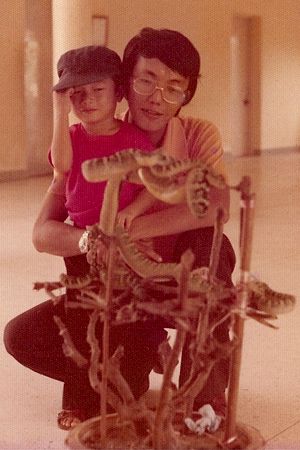
 My only recollection of Penang was from an old photo of me looking at some snakes coiled on sticks at the Snake Temple. My father had his protective arms around me. I had a slight smile but my body language betrayed my true sense of security in my father’s embrace. Perhaps that’s a child’s intuition of the destructive force that his father will later become.
I don’t remember much of Penang so my recent trip there was as good as stepping on the island for the first time. I did quite a bit of pre-trip research and the numerous travel guidebooks and websites I consulted about Penang call it the ‘Pearl of the Orient’... a title that’s been equally bestowed on Macau. But in comparing these two island cities, Penang had a higher chance of giving one a pearl necklace although Macau seemed more of a shimmering jewel with its brightly-lit casinos and neon signs.
But the most memorable and delightful part about Penang wasn’t its heavily marketed heritage treasures or much touted hawker food. It was the people of Penang that left me with the best memories. They were the true gems. The Penangnites were uber-friendly and enthusiastically helpful. In my 4 days there, not a day goes by without me thinking, “Wow, what a nice gesture that was. That person is so nice!”
Travel Facts
Travel Period : 6 – 9 Aug 09 (Air ticket and hotel booked on 22 Jun 09)
Exchange Rate : S$1.00 = MYR2.44
Air Ticket : S$83.00 (Tiger Airways, return, incl. taxes)
Accommodation : Tune Hotel
Situated along Burmah Road, Tune Hotel is less than 10 mins walk to the city centre, KOMTAR. Burmah Road runs parallel between Penang Road (which leads to the Heritage Trail) and Macalister Road (that serves lots of hawker food) so it is pretty convenient and accessible.
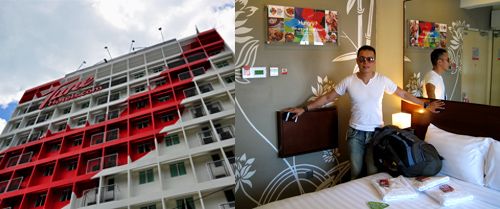
Although very compact in size, the room is clean and modern with pleasant floral prints on the walls. It is really just a place to sleep and house your luggage with very little walking space. Air-conditioning is not included in the basic room rate. You need to purchase usage hours for air-con and hair-dryer, and rent the bath towels.
Cost for 3 nights Double Room (incl. air-con usage and 3 towels) – MYR171.57 (S$70.30); approx. S$11.70 per person per night. VERY CHEAP!!
Since it’s so affordable, we extended the room for another day to house our luggage and shower before heading back as the Check-Out time was 12:00pm but our flight was at 8:00pm. The extension costs MYR73.90 (S$30.30).
CULTURE, NATURE and FOOD MISADVENTURES
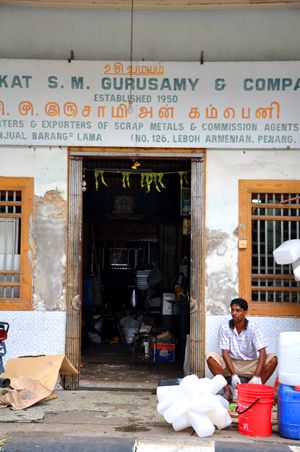 Who needs time travel machines when there’s Penang? Well, at least for me, it was a return to familiar childhood sights and scenes. A kind of displaced nostalgia where five-foot-ways bring recognition, but not the memories of me running down the corridors.
 Also known as Pulau Pinang, Penang is a live museum of the trades and possibly, way of life many decades back. The clothes may have changed, houses have internet access now, but that old world charm of unhurried ease in watching days go by lives on.
The city is deeply steeped in historic remnants and a portmanteau of cultures that earned it a place in UNESCO’s list of world heritage sites. During this trip, I covered part of the heritage trail that brought me to Chinese temples, clan houses, churches, mosques and Indian shrines (of course I can find all these in Singapore too but not within such close proximity to each other nor are many of them as old); sampled the nature-scape of this island, and dived into its famed hawker fare (though my taste buds were rather disappointed).
SNAKE TEMPLE
Without wasting a single moment, I went straight to the Snake Temple as soon as I landed in Penang. With luggage in tow, I was eager to be back here after 30 years. The Snake Temple is very close to the airport, about 10 mins by cab, but it costs MYR26.00 as the fare is fixed by the only cab operator allowed at the airport. I was told that cabs not registered with the airport cab service cannot pick up passengers at the airport. So passengers don’t have a choice but to pay the exorbitant fare it charges.
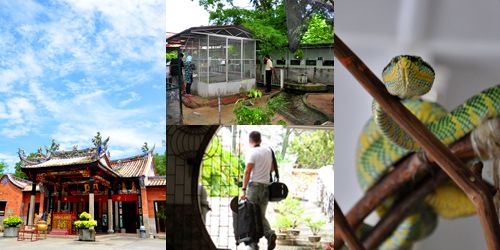
 Called the Temple of Azure Cloud (清云殿), it was built in 1850 to honor Chor Soo Kong, a monk held in high regard for his ability to heal. From what I read, snakes appeared at the temple to seek refuge after the temple was built. Taking it as a good omen, the snakes were welcomed and allowed to roam freely in the temple. However, during my visit, my burning question was, “Where are the snakes?!” I don’t even see a worm around, let alone free-ranging poisonous vipers! The vines for snakes to climb are all empty (I was later told by a cab driver that snakes are lesser in numbers now because crows come and pick them off the open-air branches).
In order to see some snakes, I had to pay MYR5.00 to visit the in-house Snakes and Reptile Exhibition. It was a poorly maintained, sort of makeshift apology for the lack of snakes in a Snake Temple. I don’t blame them if the snakes were not there since they come and go at will. But to cash in on the temple’s repute? And a haphazard one at that! I was very disappointed.
Exiting from the rip-off exhibition, I came to an area where tourists pay to get their photos taken with pythons around their necks. There were some green and yellow snakes coiled atop fake branches and stakes. They were rather high up. They don’t look real. I thought I smelt rubber on them.
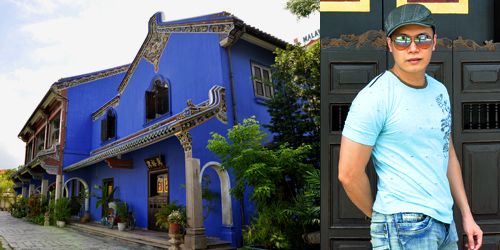
CHEONG FATT TZE MANSION (a.k.a. Blue Mansion)
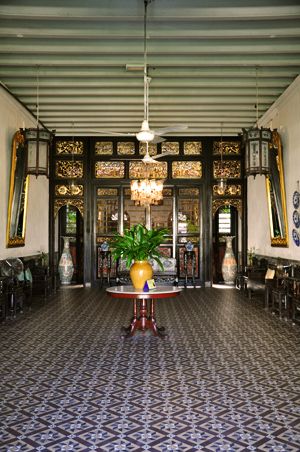
It is blue alright. And one of the bigger attraction in Penang. But I call it the ‘Boo’ Mansion… like how L.A. soccer fans booed David Beckham off the field and calling him a fraud. The curators at the Cheong Fatt Tze Mansion have such a snooty attitude, I can see the pi sai (Hokkien for ‘snot’) in their upturned noses.
 From the website, I read about the mansion’s heritage and knew that there were daily guided tours at 11:00 am and 3:00 pm. I arrived at the attraction at 3:05pm without an intention to join the tour. At the entrance, was a white-haired old man, seated, with very pale skin. He asked, “Are you here to join the tour?” “No.” I replied. “I’m here to see the mansion.”
“Then you cannot go in. You must join the tour. It’s MYR12.00 per person,” he said.
“But I don’t need a tour, I just want to see the mansion. And it past the tour time,” I replied.
“You can still pay and catch up with the tour because it just started,” he continued.
“You mean I can only see the mansion during stipulated tour times? That’s not stated in your website…” I protested.
“It’s written there (pointing to a notice panel by the door), you cannot read is it?” he asked.
Without a choice, I paid the entrance fee. Then he added, “There’s no taking of photos in the mansion. You can only take photos outside the mansion.”
 What the f@#*! I came here because the mansion is beautiful and I want to photograph it and I paid f@#*king MYR12! But the worst was yet to come.
The tour was conducted by this matronly lady who was very articulate, but probably too proud of her knowledge about feng shui of the Boo Mansion, and talked down to us with an air of superiority. I agree that the precision feng shui plan and studies that went into the construction of the mansion was remarkable, but spare me the smugness of knowledge. Even the Caucasian tourists among the group were seen giving each other the look of exasperation countless times, not because of what was being said, but how it was said.
To top it off, there’re addition staff that follow you around during the tour to make sure your don’t side-step or take photos. The Boo Mansion house guests and only they have the privilege of photographing the place from inside. I can understand that special treatment. Then my point is, don’t charge freaking MYR12.00 for an hour’s tour and please state clearly in your website that non house-guests can only visit the mansion at the 2 stipulated tour times. And please inform the unknowing public that we’re not allowed to take photos of the interior.
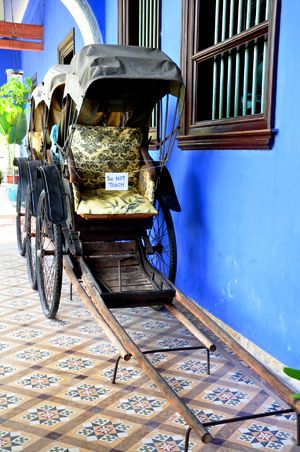
The sign on the trishaws says “DO NOT TOUCH”. The curators don’t even bother to add ‘Please’. If I’d know earlier, I wouldn’t have come here because this place adds nothing to me by being physically present.
KEK LOK SI TEMPLE
Never mind that my first day was a little disappointing. I look forward to visiting the biggest Chinese temple in Malaysia on the second day. And it rained.
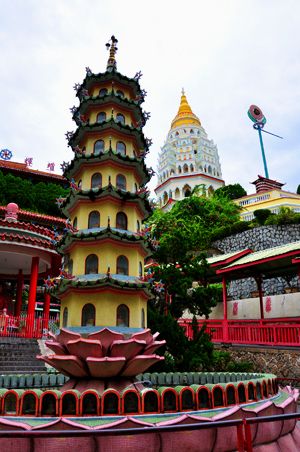 The weather at Penang during August was rather erratic. It’s sunny, gloomy and rainy all in one day. Nevertheless, we hired the van from Tune Hotel to take us to Kek Lok Si Temple. The 20 mins single trip costs MYR25. Getting around Penang in hired transport sure is expensive!
Kek Lok Si sits atop a hill at the Air Hitam precinct and is purported to be the largest Buddhist temple in Malaysia. It has three parts – lower temple where all the retail shops are, mid-temple where the thousand-Buddha pagoda stands, and the top level where a gigantic statue of the Goddess of Mercy towers (unfortunately, the statue is covered in scaffolding now due to construction works for a pavilion to house it). You can take a cable car from the middle to the statue and it costs MYR8.00 for a two-way ride.
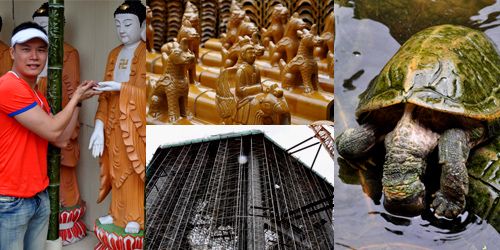
If not for the morning showers, I could imagine what a spectacular view the temple offers. You can see the whole of Georgetown (Penang’s downtown district) while lush green hills shrouded in mist surrounds you. I felt uplifted and in awe of the not-so-distant hilltops dressed in fog. There’s also a liberation pool at mid-temple where hundreds of tortoises are released into captivity. Such an irony. Some of the tortoises are really huge and looked like they’re of the same species. You can purchase vegetable at MYR1.00 a bunch and feed it to the reptiles.
This place is definitely worth a visit.
KHOO KONGSI
I almost missed out on Khoo Kongsi because with so many preserved buildings listed on Penang’s heritage trail, it can get overwhelming. Even when asked on the street, not every
 Penangnite knows where the location of some of the heritage buildings because like one of them said, “There are so many!”
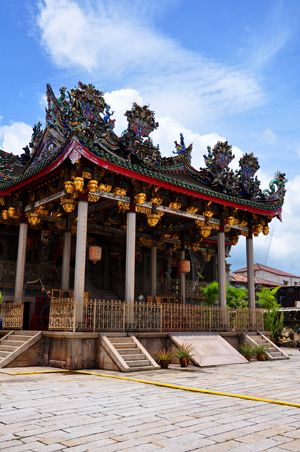
Hidden in an alley within rows of nondescript pre-war houses, the splendor and intricately decorated Khoo Kongsi resides. For an entrance fee of MYR5.00, I must agree that this place is a must-go because not only is the building opulently decorated, the owners cleverly turned the lower level into a gallery and museum about Khoo Kongsi. This gallery and its exhibits are definitely kept in better condition and more interesting than the junkyard at the Boo Mansion that showcases artifacts and vintage memorabilia.
Built in 1901 and founded by Hokkien immigrant workers in Penang, the Khoo Kongsi is rooted firmly in Confucius’ values such as filial piety and respect for the elderly. The clanhouse even has a room with plaques that list notable members of the Khoo clan that have done the community proud. There’s even a mock-up of a kitchen scene of how early settlers lived and dined at this club that also serves as a prayer hall.
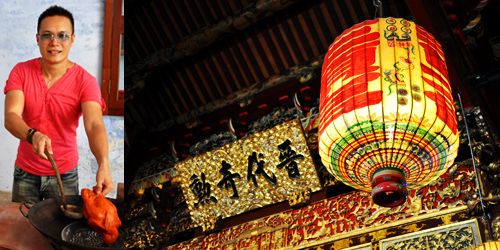
Like many of the Chinese temples and clanhouses in Penang, the rooftop of Khoo Kongsi is cluttered with the Chinese architectural art known as 'Chien Nian' (剪粘) where colourful shards of glazed ceramic are pasted together to form decorative objects. These objects are usually auspicious symbols in Chinese mythology such as dragons, phoenixes, and celestial scenes. But to me, it's a whole mess up there! A beautiful mess nonetheless.
BUTTERFLY FARM
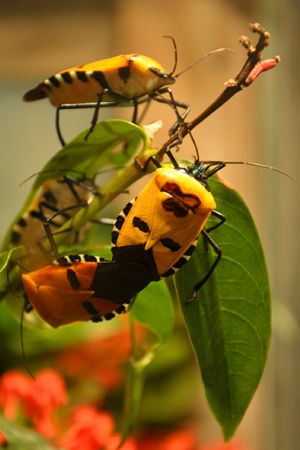
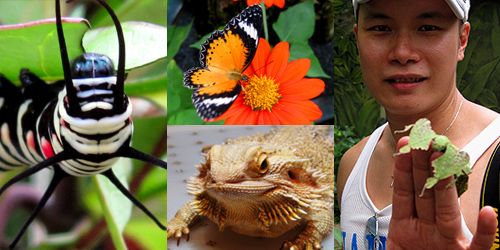
I loved this place for the opportunity to get up close and very personal with creepy crawlies. And the best part is, I get to touch and hold them! Totally awesome! Many of the insects look fearsome and dangerous but are actually very docile and gentle. I got friendly with a few species of mantises, giant millipedes and a horned lizard native to Australia.
 The Butterfly Farm is about a half hour’s drive from Georgetown and an entrance fee of MYR20.00 for adult applies. I think they have different prices for different types of visitors. We were asked where do we come from and when I replied Singapore, the ticketing person immediately said MYR20.00 per person. On the counter, I saw tickets in denominations of MYR20.00, MYR15.00 and MYR10.00 (for children).
Walking into the farm, I felt like I trespassed the lair of fairies… but with a strange smell of overly ripe bananas. Established in 1986, the farm supposedly housed around 4,000 butterflies from 120 different species. But I counted only around 10 different types. Yet, it was still a magical experience. From what I read, if you put on sweet smelling perfume, the butterflies will land on you. I don’t usually put on perfume but two butterflies did land on me. Maybe they like my B.O.
There are two showtimes at 11:00 am and 3:00 pm where visitors can learn about and feel some of the insects. But my favourite was the leaf mantis in the general exhibit area. It really looked like a piece of leaf from the plant it was hanging on to and when you hold it in your hand, it moves around gingerly in a tapping manner and is so very polite.
There are also man-faced beetles, giant weevil beetles, exotic reptiles and glowing scorpions in encased exhibits too. These creatures are really amazing and beautifully designed. Just pray your visit does not coincide with sweaty school groups that emit a natural human insecticide. In addition, if you're prone to car sickness, the winding road along Batu Ferringhi that leads to it will be a puke fest.
TOY MUSEUM
Before coming to Penang, I didn’t know there was a Toy Museum. But even if I knew, it wouldn’t have been an attraction for me. I guess I had too many things to worry during my
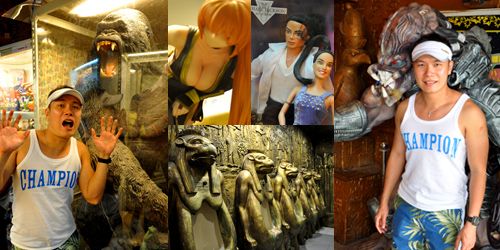
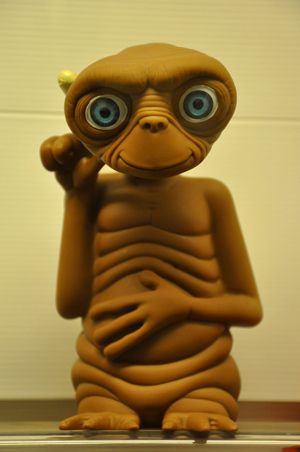 childhood than playing with toys. But I did have a collection of Zoids, M.A.S.K. and He-Man toys. And also the ET figurine in the picture. I had one just like that with its finger tip lighting up whenever I pressed a button. At one point, it was my favourite toy.
We came to learn about the Toy Museum from a flyer. Since we had time and it was along the way back from Butterfly Farm to Georgetown, we decided to pop by. The biggest draw for me was not the toys, but what was on the flyer. Printed on both sides, the A4 sized leaflet was laid out with thumbnail images of toy exhibits there. But in many of the photos, a bespectacled uncle in white shirt appeared in them posing with the life-size toys. I think he must be the owner or something, but such misguided self-promotion was hilarious. My pic below taken with King Kong was an imitation of his pose with that same exhibit.
At the museum, expect to see many different series of toys housed in glass shelves and some life-size replicas of movie characters and heroes. A lot of the toys were playsets from movies or TV shows spin-offs such as Star Wars, Spawn, Lord of the Rings, Alien, Disney and Pixar cartoons, Japanese anime, Barbie Dolls, etc. Some of these toys, especially the ones with lots of blood and gore and the undead, were very captivating. They looked so real and eerie. I’ll post photos of these toys on my Facebook later.
The entrance fee was MYR20.00 per adult although in the flyer, it was stated to be MYR10.00. It would be worth the visit if it was the latter ticket price but not at MYR20.00. I spent only about half an hour there and the museum didn’t even have the Zoids and M.A.S.K. toys that I collected so fervently. I even cleared out 4 glass shelves in my room to display toy models of Switchblade, Raven, Thunderhawk, etc from the cartoon series.
But that’s just what I remembered of my toys. You may find a piece of your childhood there and rekindle some of that joy and memories like what ET did for me.
OTHER SIGHTS IN PENANG
For a first-time visitor to Penang, there’s pretty much to see if you’re into culture and heritage artforms. But for the many restored buildings or those left in disrepair, the pre-war colonial buildings are a common sight shared by Singaporeans, and possibly many others within the Asian region, during the British / Portugese invasion. We build monuments of who we are lest we lose our beliefs and identities.
Although there are many architectural symbols that marked an era, and many with great stories behind their construction, their value today lies in their ability to entertain, amuse, or awe. With an overcrowding of stories, lest not overlook the quiet pieces of history, manmade or natural, to fully appreciate what Penang tries to preserve. Without belittling the efforts and passion that went into building beliefs and history, here’re images of sites I met with sight, but not understanding…
WAT CHAIYAMANGALARAM
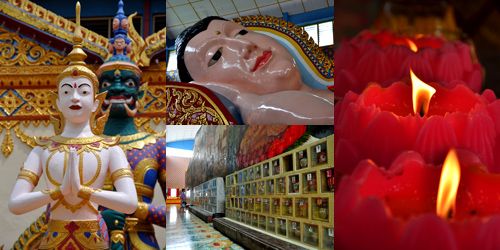
A Thai temple located at the Pulau Tikus area with a gigantic reclining buddha and columbarium. There are also 12 buddha statues there representing each of the Chinese zodiac sign. It is believed that if you make a donation at the statue that corresponds with your sign, good fortune and blessings will befall on you.
DHAMMIKARAMA BURMESE TEMPLE
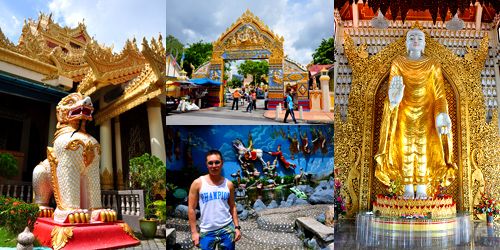
Opposite the Thai temple is Dhammikarama Burmese Temple. The two temples' parallel location make for a good study and comparison of their approaches to Buddhism. Well, I'm not much enlightened at their differences but I can see that the Burmese like bearded beasts. Maybe the beard is a sign of wisdom or trustworthiness?
This temple was supposedly founded earlier than Wat Chaiyamangalaram and was probably the reason why the lane that leads to these temples is called Burma Lane. The temple houses a gigantic standing all-marble buddha. There're also loads of brightly painted statues there with a buck-toothed nymph being my favourite!
BATU FERRINGHI AND NIGHT BAZAAR
Batu Ferringhi is the beach resort stretch in Penang with loads of hotels situated alongside the waterfront. I had intended to soak up the sun and chill out here on returning from the Butterfly Farm but problem was, I couldn't find a stretch of the beach that looked proper for such activities! Maybe the hotels had blocked and hoarded the best of the seafront, the place looked nothing like the bright sunny, activities-filled photos I saw. And the day I went, it rained and the sky was grey and sulky.
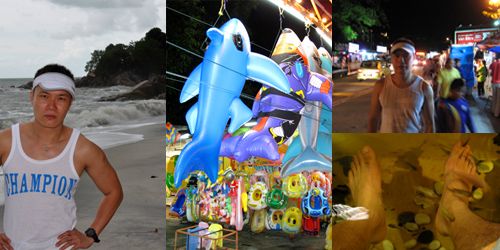
At night, Batu Ferringhi lights up as one of Penang's more popular night bazaar. You get lots of T-shirts and counterfeit garments plus something interesting knick-knacks but at a price you must be prepared to bargain. I overheard a stall-owner asking for MYR30.00 for an item. The buyer decided to walk away and the price was slashed to half. Still unconvinced, the stallowner decided to settle for MYR10.00.
As someone who is too benevolent at price haggling, I skipped shopping with price ambiguity and headed for a fish spa... you know, those places where you stick your feet into a pool and becomes a buffet for a horde of fish. It was my first time. But the perpetually hungry shoal didn't go easy on me.
For MYR30.00, I got 30 minutes to try two pools... one with smaller fish, and the other with larger swimmers up to 7 centimeters long. It was damn ticklish! Especially with the smaller fish. But after a while, I got used to the tickling feeling and it sort of got therapeutic from watching the fish coming to you. I don't know if eating my dead skin was their main source of sustenance, but knowing that you fed someone, or something, and it is alive because of you, was magnetic for me. I hoped I had more dead skin.
CLAN JETTIES
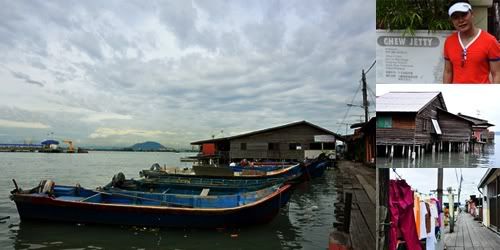
"I go there with you... where the streets have no name... I can't take my eyes off of you." So sang Pet Shop Boys in the song that I so remembered, especially in contrast with a jetty of different households with the same surname! But I can't take my eyes off of Lim nonetheless.
This is the Clan Jetty in Penang. It is also known as Weld Quay where a collection of houses on stilts form clan 'villages'. There're a total of 9 stretches (if I recall correctly), and each stretch of houses are home to families with the same surname. That is, if you go to the 'Chew' jetty, everyone there has the surname 'Chew'. From what I read, I don't see 'Ng' jetty, which is my surname, but I guess the jetties must be home to surnames from the Hokkien province of China. I belong to my paternal dialect group of Hing Hwa, which I believe is a dialect of Hokkien (imagine a dialect or a dialect!), but I never quite confirmed my ancestory.
Well, I live in Singapore and I'm encouraged to speak good English and good Mandarin. That's the Singaporean identity. Dialects are seen as cumbersome and undermining of progress because the human brain can only store a certain number of languages. If we allowed dialects, we will sacrifice the full comprehension of profitable languages. I am relatively bilingual but I also understood the world through Cantonese and Hokkien descriptions of life. I never quite learnt Hing Hwa though. It's a pity to lose the ability to express and be understood in non-mainstream languages, because they provide the last lineages to our heritage. So here's Penang, still preserving and proud of its homage to tradition.
GETTING AROUND & MOVING ABOUT
Penang isn't too difficult a place to navigate. The Heritage Trail with all its buildings of interest can be covered on foot as they're pretty close to each other. Wherever you walk, just look up and use the Komtar building as a reference point because it towers above everything else in Georgetown.
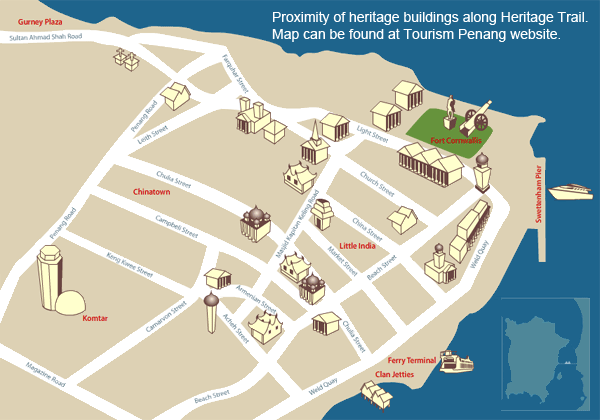
To visit the Heritage Trail, you can also hop on the FREE shuttle bus known as the City Area Transit (CAT). The bus is pretty frequent (I think every 10 mins or so), air-conditioned, clean and comfortable. The bus travels in a loop and passes many of the heritage buildings. You can hop on the bus at the side of a bus interchange next to Komtar. Or you can take one of the many trishaws to visit the sights and experience yesterday once more, except that you'll be sucking up car fumes and bring about global warming in your body.
Alternatively, you can try taking the public buses which charges about MYR2.00 per trip. The buses are of a standard much like the SBS buses here in Singapore. But always ask the bus driver if your destination is in his route because it seems like the same bus number at the same bus-stop can have different routes.
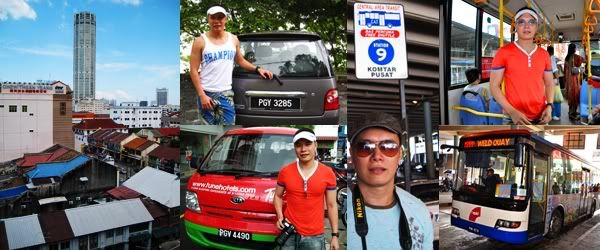
There many ways to get around in Penang, but do you know what's the worst way? It's by cab. It's pure daylight, and night time, robbery! The cabs don't go by meter so you'll have to negotiate the fare before getting on. I've mentioned how much it costs to get from the airport to the Snake Temple earlier, and from the temple to Georgetown, a ride of about 20 mins, the fare was MYR35.00! And a cab we took back to hotel after a night at Gurney Drive costs MYR15.00 for a less than 15 mins journey.
So we decided to rent a car on the day where our itinerary was planned for further out explorations such as the Butterfly Farm, Toy Museum and Batu Ferringhi. The car rental was MYR120.00 a day. It's about a 45 mins drive to the Butterfly Farm from Tune Hotel. Can you imagine the cab fare to and fro? Initially, we wanted to book the car rental online. The cheapest was about MYR240.00 per day. Thankfully we didn't. Tune Hotel has a car rental counter and it's much cheaper. It also rents bicycles for MYR10.00 a day to bike around town and offers a hotel taxi service. Two of us took the hotel van to Kek Lok Si and it costs MYR15.00 per person. The ride was about 20 mins.
DOES PENANG FOOD HAVE TALENT?
As the date for my Penang holiday drew nearer, I announced my anticipation on Facebook and I got quite a number of trip advices. But mostly, they gushed about the great food in Penang and how "the taste is different from the hawker food in Singapore. Somehow, it just tastes better!" Frankly, I don't see what's there to rave about. The food there is platable. But forgettable.
Perhaps it's a case of 'the-grass-is-greener-on-the-other-side' syndrome, but we definintely think that the quality and taste of hawker food here in Singapore is much better. In fact, we were trying to find evidence that Penang food is tastier so we went to many places to eat. From the famous hawker district of Gurney Drive to Mcalister Road, to obscure coffeeshops by the roadside, we went to places that were comparable to eating joints we would go in Singapore.
So what's the verdict? Well, here's my gourmet report card for Penang :
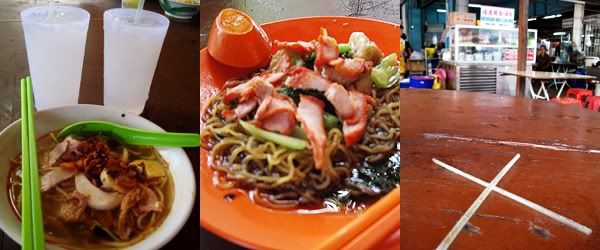
Our very first meal : Hokkien Mee and Wanton Mee at food stalls opposite the Snake Temple.
Now I know why there're no more snakes in the temple. To be near such bad food, anything would flee. The prawns in the Hokkien Mee looked and tasted like dried shrimps (hae bee) soaked in water for a week, and the dumplings in the Wanton Mee had too much fatty meat. And the barley water tasted like... hmmm... I don't know how to describe... I hope diabetic pee would begin to give you the faintest idea of what it tastes like.
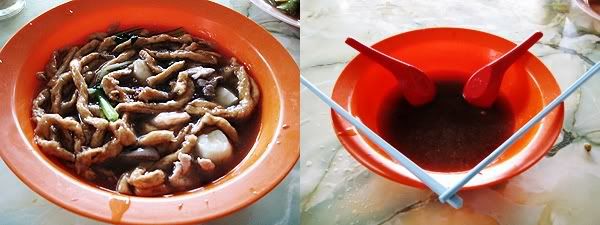
Fish Maw Noodle at a coffeeshop along the Goddess of Mercy Temple side of road.
Initially I thought it is thick yellow noodle or another familiar mee cooked in fish maw soup, but no. The noodle itself resembled stripes of fish maw with a chewy texture. I kind of like it because the noodles absorbed the taste of the gravy with the fragrance of fried flour.
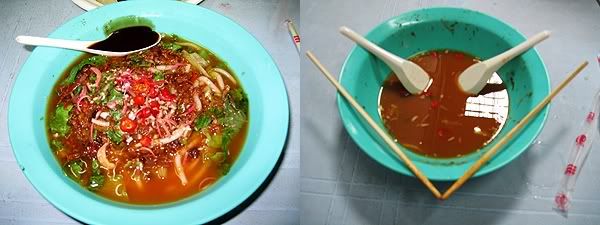
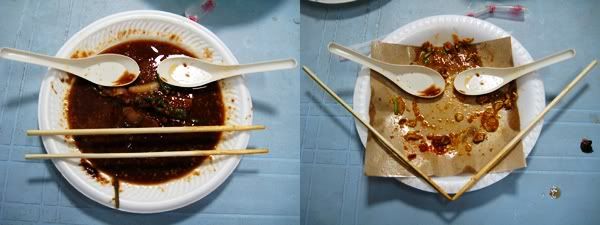
Penang Laksa, Cuttlefish with Kangkong and Oyster Omelette at open-air hawker street along Macalister Road.
These were what we had for a second dinner. Less than 10 mins ago, we had Chicken Rice, BBQ Stingray, 3 Stuffed Crab Shells, and Char Kway Teow at another hawker area further up the road. Seven items in total! Didn't take photos of the earlier dinner because we were too hungry and the dishes were no big deal. But the Penang Laksa was pretty good at this second place. The cuttlefish reminded me of skin-colored hearing aids while the Oyster Omelette was yummy. But again, it's not that yummy that I would go back again. Pigging out in Penang is very affordable. I think we spent a total of about S$13 only and we had BBQ Stingray.

Chicken Rice with Roast Pork at coffeeshop next to Tune Hotel.
The stall name is called 'Fatty' something. I can't remember. But I remembered the very friendly stallowner. All smiley and attentive, no wonder he sees a steady stream of customers. Plus, his Chicken Rice is pretty nice... Flavourful and satisfying.
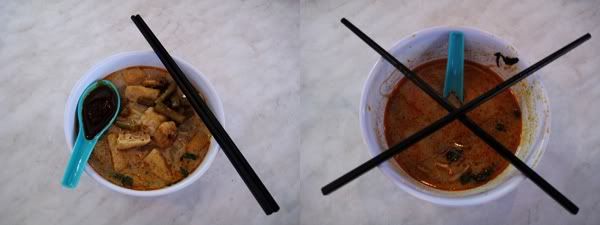
Curry Mee at New World Park Hawker Centre.
New World Park Hawker is next to Tune Hotel as well and I thought it resembled the foodcourts of Singapore sans air-conditioning. A Penangnite from Facebook suggested that I could eat here, but I think the selection and atmosphere at the Macalister Road hawkers were more authentic Penang. New World Park Hawker Centre is located along Burmah Road and Macalister Road runs parallel to it. The array of food at NWP is extensive but not all serve the dinner crowd. We were on our way to Gurney Drive for dinner but thought we'd check out NWP since it's along the way.
I wanted something that's Penang so I chose Curry Mee since I saw it often enough at other eateries. Bad choice. The curry broth lacked flavour and the cockles could be used as erasers. Bleah! I can't wait to get this mistake out of my mouth.
In the spirit to experience that side of Penang at sundown, we decided to walk from our hotel to Gurney Drive Hawker Centre. It didn't look that far on the map. We walked for over an hour to get there. I was hot and sticky, my lower back hurts, and my tongue was still haunted by those rubbery cockles.
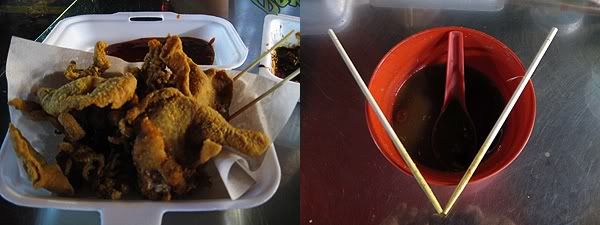
Finally. Finally we got to Gurney Drive. We shopped a little at Gurney Plaza before checking out the hawker centre nearby. The ambience reminded me of Satay Club in Singapore eons ago with huge umbrellas proped up to shelter diners. It was drizzling slightly that night. Undeterred, I ordered Penang Laksa and an assortment of fried chicken skin and calamari. Yumz!
The Penang Laksa here continued my delight of the same dish at Macalister Road Hawker. Its thick, white noodle was spongy and smooth, and the sardine broth was tasty. My only grouse is that there're no pieces of sardine meat to be found. Singapore's version of Penang Laksa is characterized by the chunks of fish meat in the soup, but in Penang, there's hardly any meat... just broth, spices, and noodles. Being protein-conscious, I preferred the meaty version.
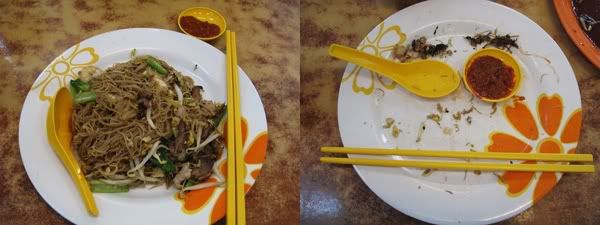
I had this dish, Salted Fish Fried Bee Hoon, at a coffeeshop around the Thai and Burmese temples. At first taste, my kidneys revolted. "We will report you to the Central Nervous System," they said. But after a few mouthfuls, they were coaxed to accept that the mouth is boss. Does this mirror the political situation in some countries?
It's interesting that the very taste that made this order detestable was the reason that it was platable. I knew what salted fish taste like but I wasn't ready for the saline flummox. I have mixed feelings about it. It's like rushing outdoors to enjoy the sunshine and then telling the sun that it is too bright.
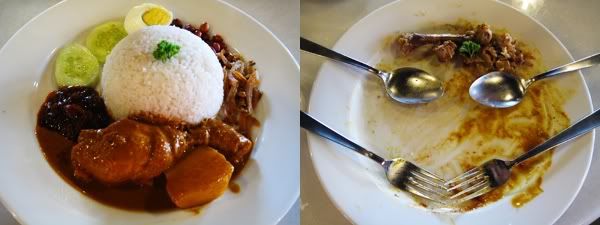
Right about the third day there, we OD-ed on hawker food.


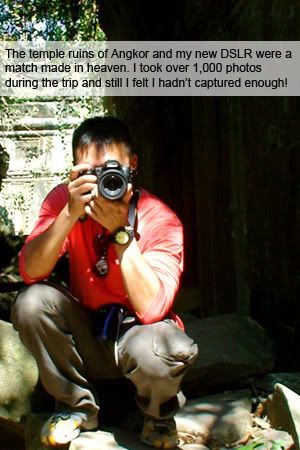 The two were a marriage made in heaven and I was on cloud nine the 5-days-4-nights I was there. In the 3 full days of playing Lara Croft, I visited 13 temple ruins of Angkor and took more than 1,000 photos! That place was so photogenic, my fingers went numb from all that trigger action. But clicking on the DSLR didn’t come naturally...
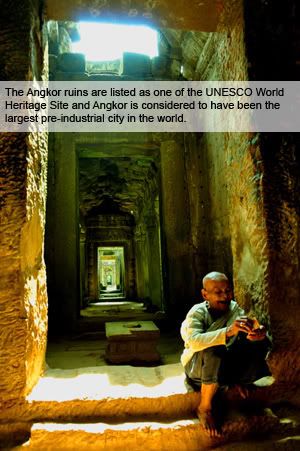 magnificence of Angkor Wat. From what I read, ‘Angkor’ basically defines a period of the Khmer empire in Cambodia from the 9th to the 15th century. During this period, the largely Hindu civilization built many temples under the self-declared ‘god-king’, Jayavarman II. The Angkorian period flourished till the time it was ravaged during the Siamese war and eventually losing its ground to the Thais in 1431 A.D. The Khmer people were forced to uproot to Phnom Penh.
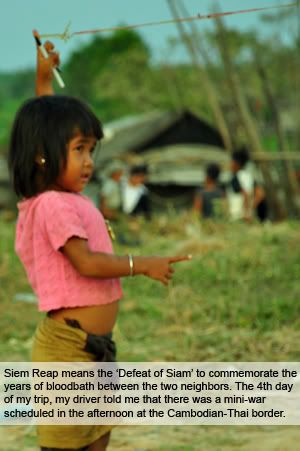 Throughout my stay there, I think the people of Siem Reap were friendly enough but I can’t help feeling that their hospitable smiles were because I’m a walking dollar note. Well, cash is king anywhere in the world, but in Siem Reap, the hoi polloi were really out to get it. Young children will follow you touting postcards, fridge magnets, flutes, handicrafts, drinks and knick-knack souvenirs while the adults call for you to buy t-shirts, eat, drink, buy bananas, pineapples, etc from as far as a hundred meters away! Perhaps it’s because the opportunity to earn the tourism dollar had a time-span.
 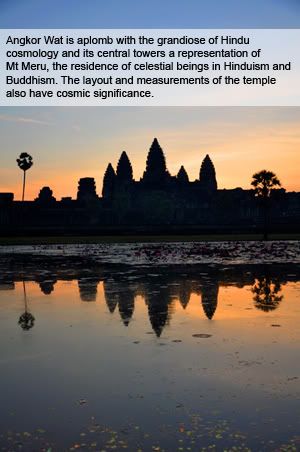 Don’t get me wrong. Angkor Wat is breathtaking in its own right. We opted to catch the sunrise over Angkor Wat so we arrived while the moon still held the sky’s black cloak as its only incandescent button. I crept onto the long bridge leading to the temple with a small torch light as my guide. I could make out the size of the architectural relic, but not its beauty. However, when I left the temple in broad daylight, I turned back while on the same long bridge and imagined what I would’ve felt if this was the first sight of Angkor Wat that greeted me. I would’ve been awed.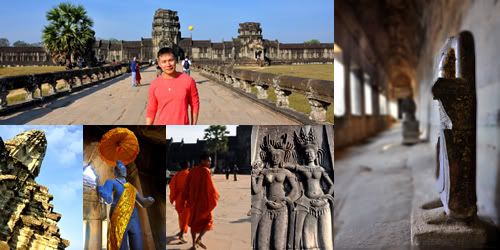
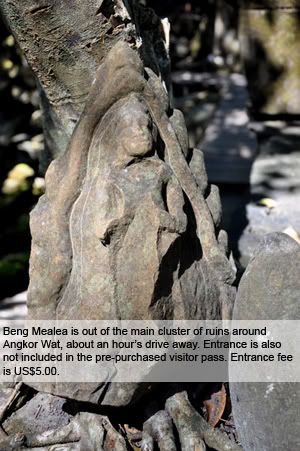 Of all the temples and sights we’d seen in Siem Reap, Beng Mealea would have to be the weakest link. For one, the ruins were located about an hour’s drive from Angkor Wat and we had to pay additional admission fee to see it. Secondly, the ruins were nothing spectacular and we literally had to climb the collapsed wall to see one part of it. The good thing about Beng Mealea was that there aren’t many tourists around but then again, the problem with our tourists is that you want them out of your picture, and at Beng Mealea, there wasn’t much to photograph in the first place.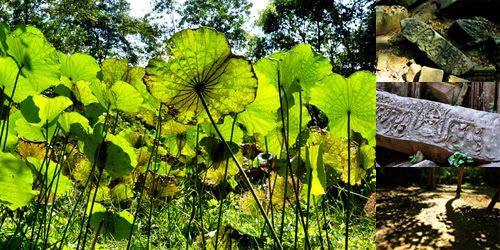
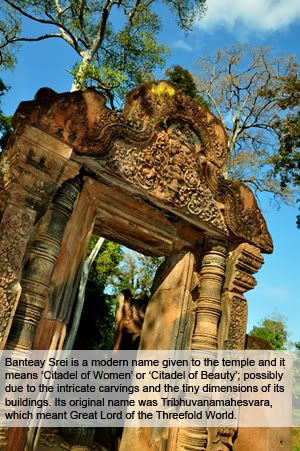 The entrance to Banteay Srei didn't seem like much. While walking up to what's left of the entrance, I thought the site was just going to be some wildly strewn red rocks peaking out from the ground and that place don't even have a roof above it. But on closer examination, the 'door' frame was intricately carved and the pertruding patterns made more vivid from the shadows cast by the afternoon sun.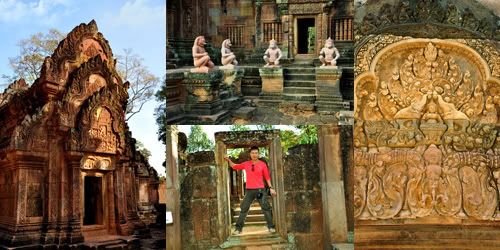
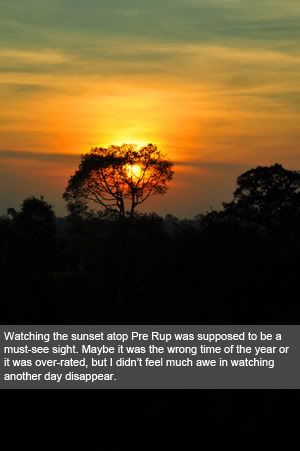 Pre Rup means ‘Turning the Body’ and it originates from the belief by the Cambodian people that this temple was used as a crematorium. Now, it is used by tourists to roast in the dusking sun for it is reputed as the best place to catch the sunset. But frankly, there’s nothing impressive about it.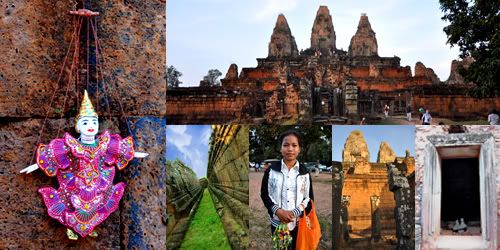
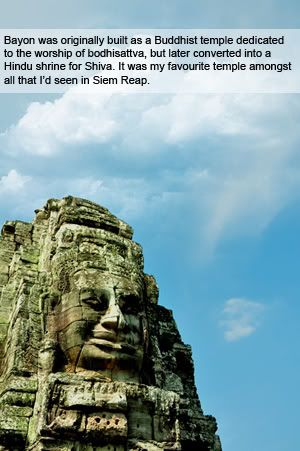 My third day in Siem Reap was greeted in the morning by the smiling faces at the Bayon temple. There’s a sort of unsettling calm about this place… on the one hand, the serenity caught on stone exudes a timelessness that neutralises the fear of mortality; but on the other, the crowding of 216 faces on 54 gothic towers in such a small area breeds claustrophobia. This place soothed and flustered me at the same time.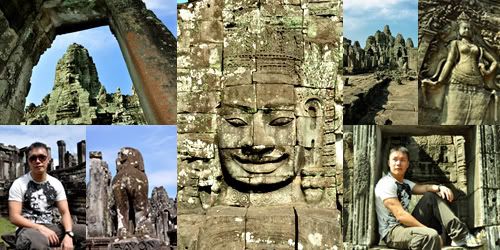
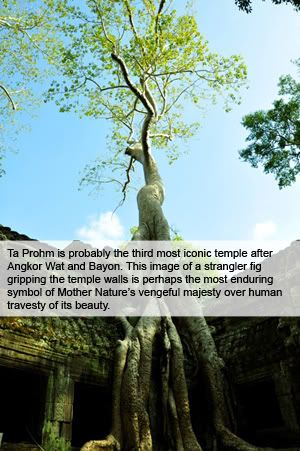 Here sits another of nature’s trophies on man’s creation. But unlike the swift catastrophe of destructive weathers, this tug-of-war between nature and man emanates a sort of eerie allure that enthralls. This temple-ruin is made beautiful by that which is destroying it. Herein lies the irony of Ta Prohm.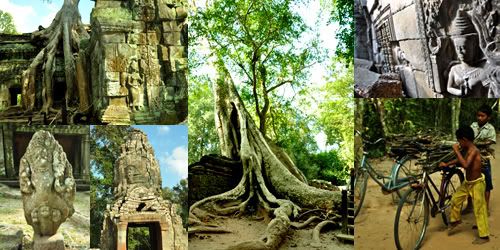
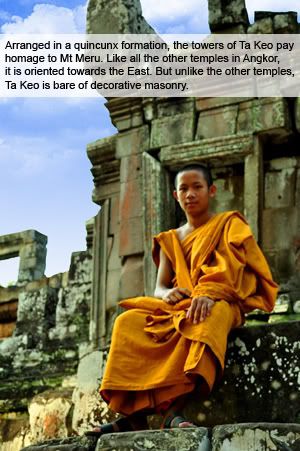 According to records, one of the towers of Ta Keo was struck by lightning half-way through its construction. Taking that as a bad omen, building works stopped and the temple was never completed. But there’re other theories about its abandonment. Some said it was never completed because of the death of its patron king, Jayavarman V, while others claimed dissertation due to the fact that the high-quality sandstone used to build this temple was too hard to carve.