05 October 2016

Tokyo (Japan) - Harajuku : Playground for Japan's Pop Couture

Date of Exploration : 27 Mar 2016

When it comes to outrageous styles and flashy fashion, Tokyo's Harajuku district is Asia's epicenter of all that is weird and wonderful. So a chance to visit this trendsetting enclave is not-to-be-missed during my virgin trip to the Japanese capital!

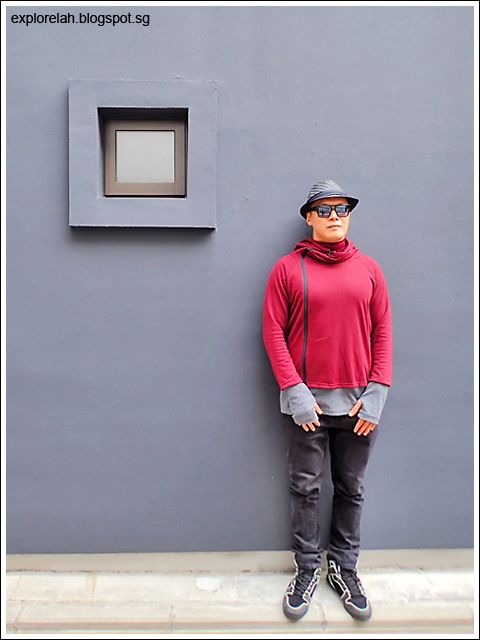
I'm not much of a fashionista but since we are visiting the hip Harajuku, have to put in an attempt at being trendy. This look can pass? :)

More than just the name of a place, "Harajuku" has evolved into a term that means a distinct, dramatic Japanese fashion style that is creatively expressive.

At the entrance to the famous Harajuku street that is the style mecca for teenage fashionistas...

... and this hip-hop grandma. I applaud her for not giving a fuck about what the world thinks and sashaying in those killer-height platforms!

Harajuku is an open outdoor playground for cosplayers who became the district's unofficial tourist attractions. Came across this "Strawberry Shortcake" who was a walking rainbow amongst the crowd.

Another cosplay apparition that proves everyday is Halloween in Harajuku. I think it is a fabulous idea to have an area where people who like to play dress up can go to any day in their costumes. It sure adds spice to life.

I came to Harajuku expecting to see a lot of outrageously dressed people and cosplayers but there weren't many. We came on a Sunday, which is supposed to be the day where cosplayers are most likely to appear, but saw only two. *disappointed*

If you are looking for clothes, Harajuku is the wrong place to come to as most shops don't sell clothes. They sell outlandish, theatrical, head-turning everyday garb that borders on being costumes.

Killer marketing with bad sign language.

Saw a lot of people queuing for this snack so decided to try. Pretty good but not queue-worthy.

The amount of people at Harajuku on a weekend is insane.

Passed the tight shopping street, I found myself at an area lined with avant garde boutique shops.

No idea where I am within the Harajuku district but laid eyes on this interesting piece of architecture.

A floral detox from all that fashion spotting.

The more subdued and less crazy side of Harajuku...

... but the overall crowd is still pretty insane at the birthplace of Japan's pop couture.
My visit was over sooner than I expected and even though I didn't come across as many as the fashionably liberated as I would like to, it was still pretty magic to have walked down the legendary fashion district that has revolutionised street style.

Now I'm inspired to be even bolder and more experimental with my choice of prêt-à-porter!

03 October 2016

Tokyo (Japan) - Ueno Park & Akihabara

Date of Exploration : 28 Mar 2016

After Asakusa Temple, we continued our exploration of the northeastern districts of Tokyo with a visit to Ueno Park and Akihabara. As all these places of interest are rather nearby, planning to see all of them together as a day excursion would save a lot of travelling time.

Ueno Park - An Attraction of Attractions

From Tokyo's iconic Asakusa Temple, we took a short train ride to Ueno Park. Other than being a scenic green escape from the concrete of Tokyo, the park is also home to a zoo (Ueno Zoo), several museums (such as the Tokyo National Museum, Western Museum of Art, National Museum of Nature and Science, Tokyo Metropolitan Art Museum, etc), shrines and themed landscapes.

With so many attractions within its grounds, Ueno Park makes for a very rewarding visit that could demand a full-day trip just to explore most of what it has to offer. But perhaps what the park is most famous for is its reputation as one of the best places for hanami (appreciating cherry blossoms) during the sakura season

I came to Japan specially for the cherry blossom season so Ueno Park was on my list of must-visit places to revel in the floral spectacle. Ueno Park is also a favourite choice for hanami parties for the locals because it is the only park in Tokyo where the consumption of alcohol is allowed.

Being a hotspot for viewing sakura, Ueno Park gets a lot of footfall with people numbering as countless as the flowers in bloom. To avoid crowds and have much of the park to yourself, the best time to visit is apparently before 10am during the sakura season.
We arrived late at Ueno Park (at around 3pm) but early for the sakura season. Most of the trees were still budding and the flowers were not in full bloom yet.
We passed by the quaint Kiyomizu Kannado (Goddess of Mercy Temple) sitting atop a hill. As we did not have a lot of time before nightfall, we rushed through our visit of Ueno Park and did not visit the various attractions and points of interest within its vicinity.
I can imagine how spectacular it would be when the floral canopies are in full bloom.
As different species of cherry blossoms with slightly different blooming periods are planted in Ueno Park, we were rewarded with these early sprays of pink so our trouble to get here wasn't in vain.
Sakura flowers are pretty alone and beautiful together.
Groups of people spread picnic mats along the paths lined with sakura trees for hanami parties and gatherings. Consumption of alcohol is permitted in Ueno Park so can you imagine warming up with some sake (Japanese rice wine) in the cool spring air amidst drifting petals of sakura? Ahh... it would be bliss! Except that the green hoarding destroyed any sense of beauty!
Silly jump shot at the vast plaza in front of Tokyo National Museum.

A brief time photographing the sakura blooms later, the sun began to set and we hurried off to our next destination. If I visit Tokyo again, I would definitely come back to Ueno Park to check out the zoo, temples and museums. And I would definitely start my visit much earlier so as to see more!

Akihabara - Plugging into the Anime Pulse of Tokyo

Departing Ueno Park, we had wanted to walk over to Bunkyo Civic Center, which has a free-access observation deck on the 25th floor, to catch the sunset over Tokyo. On a clear day, you can see Mount Fuji from the deck.

In my research, Bunkyo Civic Center didn't seem too far a walk from Ueno Park but because I was being cheap, I didn't get a local data SIM card so that I can activate Google map for way-finding and relied on asking our way to where we wanted to be. Thinking that Bunkyo Civic Center would be a well-known landmark, we asked the police at Ueno Park and several passers-by along the way but no one knew where the building was. We even showed them photos of the building only to receive blank stares.

We walked along Showa-Dori road, which is an arterial road next to the entrance of Ueno Park, and about 30 minutes later, we ended up at Akihabara! I've planned to go Akihabara after Bunkyo Civic Centre but unwittingly, we've arrived at Tokyo's famed tech district without knowing that we could actually walk to Akihabara from Ueno Park. Oh well, it was a pleasant surprise although we didn't get to see the sunset over Tokyo as hoped for.

Welcome to Tokyo's geekdom of tech and anime!

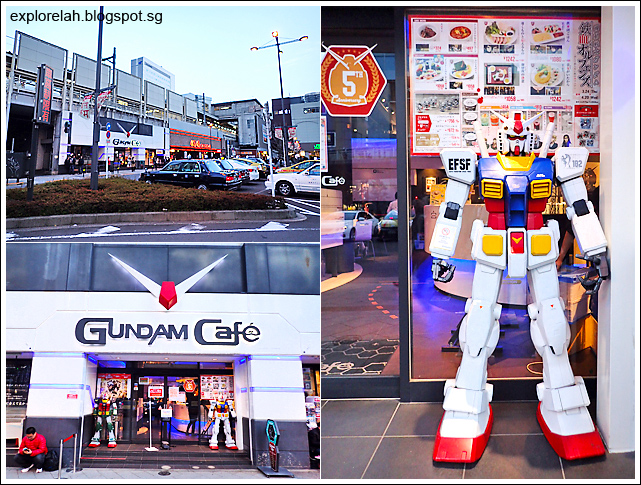
Other than electronics, Akihabara is also a come-to place for entertainment-themed restaurants and cafes such as the AKB48 Cafe and Gundam Cafe. AKB48 is the wildly popular girl band group which has 48 members! And 'AKB' is short for Akihabara because this is where it all started.
I came to Akihabara not because I'm a techie but for the area's famed maid cafes where diners are served by cute girls in maid costumes. Ok, I know what you are thinking... that I'm a dirty old man satisfying some BDSM fetish but I'm not. I'm just curious about this peculiar cafe culture that is every schoolboy's and horny men fantasy.
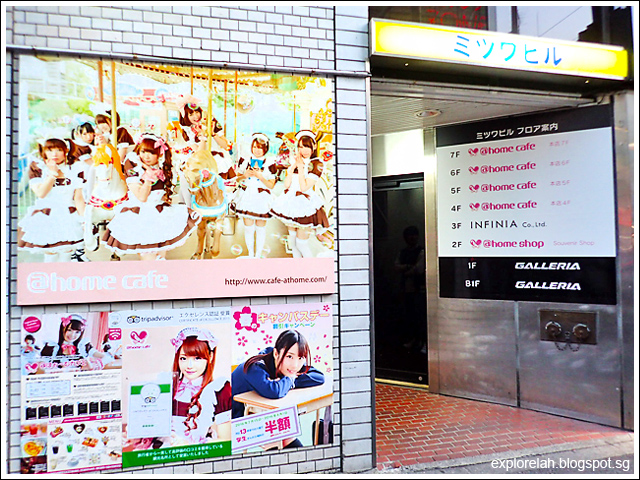
One of the most famous maid cafe is @Home Cafe. At the cafe, you are treated like a king where the maids will serve you, play games with you and even feed you! I was really psyched about the experience of being pampered but my companion didn't feel comfortable with the idea so the lift lobby was as close I'd gotten to @Home Cafe.

There are many different kinds of maid cafes in Akihabara. Some have games as part of their services while others engage you in handicraft or performances. I think it's a blessing that I didn't go into the maid cafe. I would probably take over their jobs since it sounds like so much fun! LOL

Since we gave the maid cafes a miss, we decided to check out Gundam Cafe, which is next door to the AKB48 Cafe.
Piecing together plastic robots was one of my favourite past-times as a kid and I had shelves full of Gundam bots and mechanised Zoids on display. Whatever ang pow money I got during Chinese New Year would end up on those shelves. So I was also pretty psyched to dine at Gundam Cafe. But luck wasn't on our side. The cafe was closed that day for a private event! *tear out my hair*
It was quite a string of non adventures at Akihabara but there's no denying that the district possesses a great potential for unusual experiences that is centered around the uniquely Japanese culture of manga / anime. And here's me trying to audition as the next anime star. Ooi... stop puking okay?!
From soaking in the religious traditions at Asakusa Temple to sakura viewing at Ueno Park to stepping into the future at Akihabara, we encountered 3 very distinct facets of Tokyo that are so very different all in a day. What can I say except that I'm totally loving it in Tokyo!

13 July 2016

Kyoto (Japan) - From Modern to Time-Trodden

Date of Exploration : 29 Mar 2016

After 4 days in Tokyo, we bade the eclectic capital city farewell and made our way to Kyoto. We were initially anxious about securing train tickets from Tokyo to Kyoto but there was really no need to worry as the frequency of trains plying between the two cities is very high.

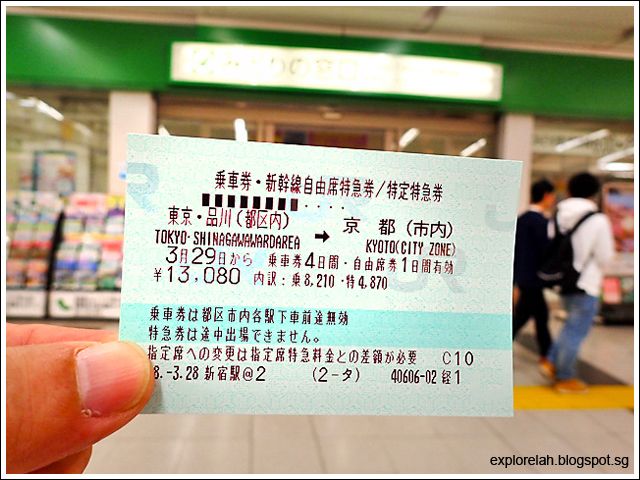
A train departs Tokyo for Kyoto once every about 20 minutes so it wasn't necessary to pre-book tickets online. But being kiasu, we bought the tickets a day in advance at one of the ticketing outlets at Shinjuku Station where our hotel is near. During peak tourist season in Japan such as during the sakura season, it is advisable to buy tickets earlier in case tickets get sold out on the intended day of travel.

As Japan's train network is notoriously confusing, one trick I've learnt is to always look for a station's control booth next to the entry / exit gantries or information counters to ask and confirm details before making a ticket purchase. They are very helpful and most of them speak decent English so there's really no reason to get lost. When in doubt, just ask.

We bought the train ticket from Tokyo to Kyoto a day earlier on 28 Mar to travel on 29 Mar. The one-way train ride costs ¥13,080 (approx. S$172) for the non-reserved seat and takes about 140 minutes (2hrs 40mins) between Tokyo and Kyoto.

A non-reserved seat means that you don't get an assigned seat and have to get on the train carriage to look for an empty seat. If the train is full, you'll have to wait for the next one. A reserved seat would be one where you are assigned a seat number but it would costs more per ticket (
¥14,000 / S$184).

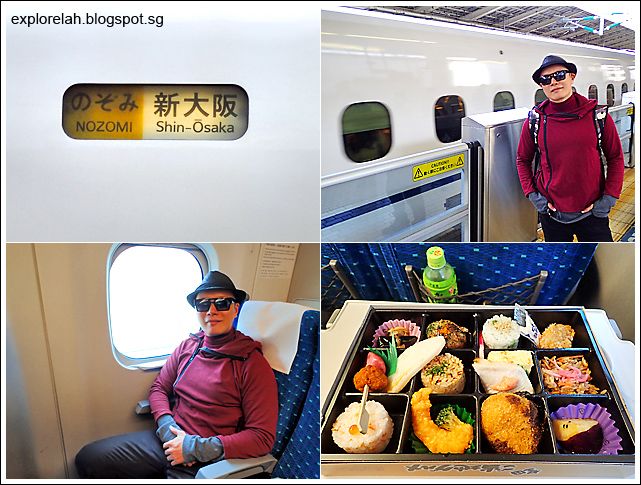
The sleek Shinkansen (Japanese bullet train) that look like they just arrived out of a sci-fi movie is our ride from Tokyo to Kyoto. The train line that connects Tokyo to Kyoto is known as the Tokaidao Line.

Now, this is where it gets complicated. There are different travel durations for the Shinkansen to reach Kyoto - Nozomi train takes 140 minutes, Hikari train at 160 minutes and Kodama train is the slowest at 4 hours. So check the departure noticeboards and board the right train as all train tickets to Kyoto cost the same price. And make sure you board the right class - Reserved or Non-Reserved seat, which are indicated outside the train carriages.

The Tokaido Line actually links Tokyo to Kyoto and then onward to Osaka so it is not uncommon to see Shin-Osaka or Osaka listed as the final destination of a Shinkansen train. But always, when in doubt, ask a fellow passenger or a train captain who strolls pass as they change shift before getting on a train. I asked 3 different people to confirm the train I was getting on goes to Kyoto before I got on.

There were a number of food shops at Tokyo's Shinagawa Station which offered very pretty looking bentos which we bought to fill up during the long ride. A set of these tic-tac-toe bento boxes costs around S$10. And don't worry about eating or drinking on the train as there are toilets on board in case you have a very active digestive system.

A passing glimpse of the snow-capped tip of Mount Fuji. When visiting Japan, one of the trophies to bring home is a photo of Mount Fuji is full view with its white tip. However, due to weather and environmental conditions, getting an unobstructed and clear view of Mount Fuji with its summit covered in white snow depends a lot on luck.

We didn't get to see the iconic mountain's summit when we visited Lake Kawaguchiko, a prime spot to see and photograph the famous mountain. But on our way from Tokyo to Kyoto, I caught a fleeting glimpse and thus this photo of Mount Fuji's white-capped top! Here's a tip... when facing the forward direction of the train, sit on the right side (see photo above) for a view of Mount Fuji passing by your window. Mount Fuji is visible about 35 minutes into the ride so prepare your camera!

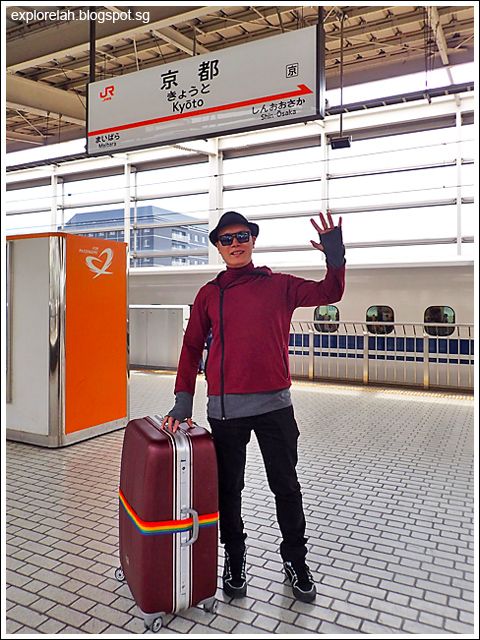
Hello Kyoto!
We left Tokyo at about 11:50am and arrived in Kyoto at 1:10pm. The trains are very punctual for departure and arrival which made the whole travelling experience so definite and predictable. Love the Japanese for that!

I come in two pieces... my luggage and me. Lesson here is not to play matchy-matchy with the luggage as it's hard to discern which is which.


Our nest in Kyoto was Hotel Brighton City Kyoto Yamashina which was near a local train station and easily accessible. The hotel comes with free usage of an indoor onsen that has stipulated schudules to separate male and female usage of the shared hot pools.

We paid S$495 for 2 nights here. Our room was very compact like most Japanese hotels but it has quite a nice view in the direction of the train station with mountain ranges in the background. After we put our luggage and bags, we had to tip-toe around the room.

One major convenience we enjoyed about Hotel Brighton City (Kyoto, Yamashina) was its next-door proximity to Daimaru shopping mall via an underground link. This provided a great opportunity to go food shopping at the the mall around 7:30pm when ready-to-eat stalls at its supermarket section start offering steep discounts for quick sale of their perishable bentos, snacks and meals.

We bought 3 sets of sashimi
after discount at ¥980 (S$4 each) and delicious bentos for about S$6 for dinner. It was a sumptuous budget feast in bed!

Down the Way of Bygone Days

After dropping off my dressed-alike luggage at the hotel, we headed straight for Gion, the heritage district of Kyoto. It was just a shot train ride from Yamashina Station where our hotel was to Gion and we were instantly transported to a time-yellowed era of Japan's yesteryears.

Kyoto is so very different from Tokyo. The streets are quieter and pace of life slower with  countless remnants of the old world beautifully aged in place. 

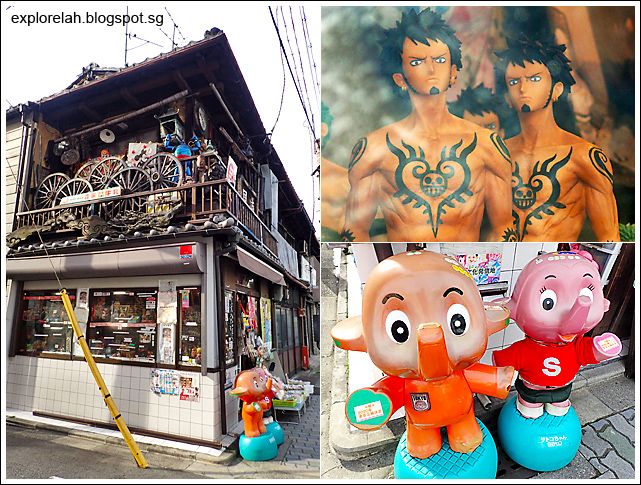
Antiques within an antique... Passed by this vintage toy shop that is itself a piece of history. I had a hunch that early sex toys were disguised as elephants.

This roadside lavatory that resembled a slice of Swiss Roll Cake cracked me up! Guess many would be doing some baking inside.

Wood you still love me tomorrow?

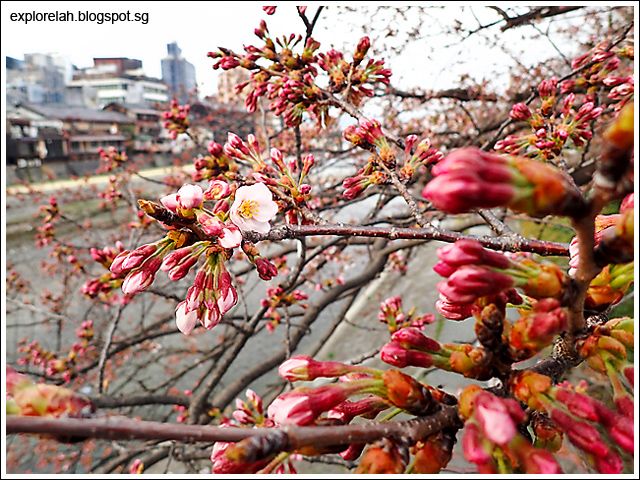
First bloom of a sakura tree reaching towards Kamo River taken on Sanjo Ohashi Bridge.

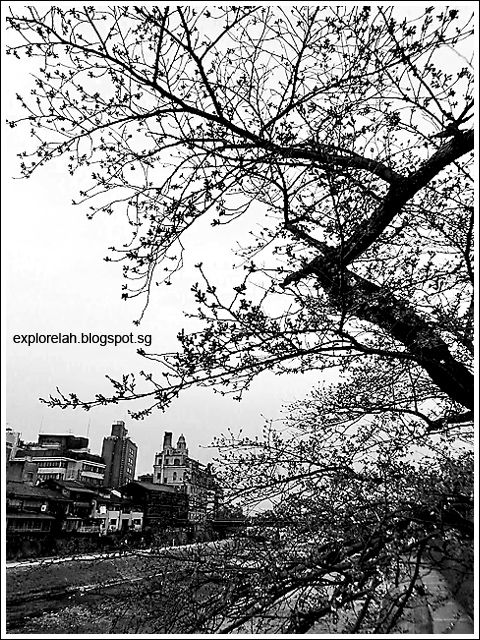
Pulling back a little more, this is the same sakura tree as the one above in black-and-white with Kamo River to the left. The river is near the Gion old quarters.

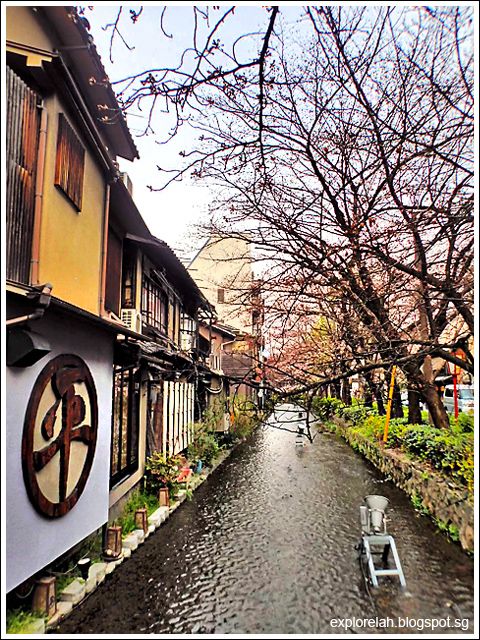
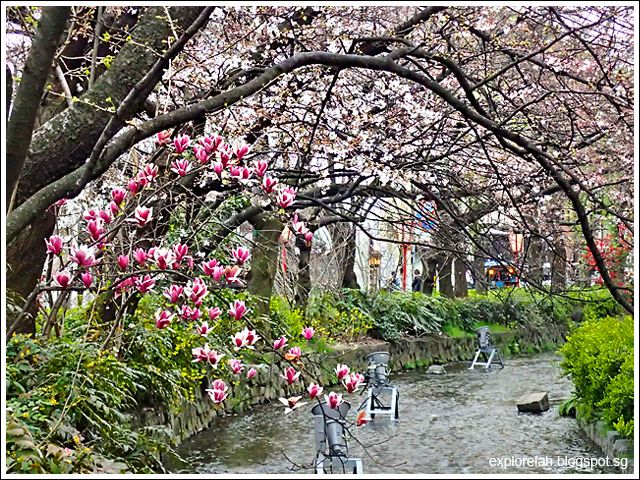
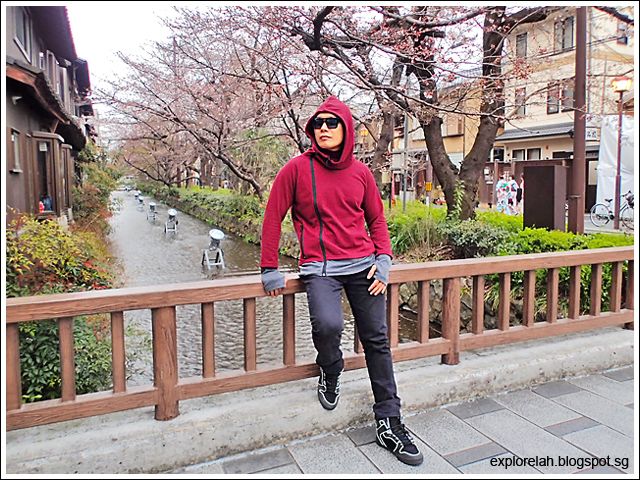
Crossing Sanjo Ohashi Bridge over Kamo River from Gion, I was brought to a very quaint neighbourhood of restaurants and cafes along Kiyamachi Street. With a canal lined on one side with old shophouses and the other with cherry blossom trees, the street is a natural lens pleaser. But this place is not to be confused with the Shirakawa Area which is the most scenic old streetscape in Kyoto.

Double flower power! A pink magnolia tree held its ground to attract eyeballs amongst the crowd of sakura blooms along Kiyamachi Street. I think the 2 flowers complement each other wondrously.

Pink magnolias typically bloom in spring on a bald tree.

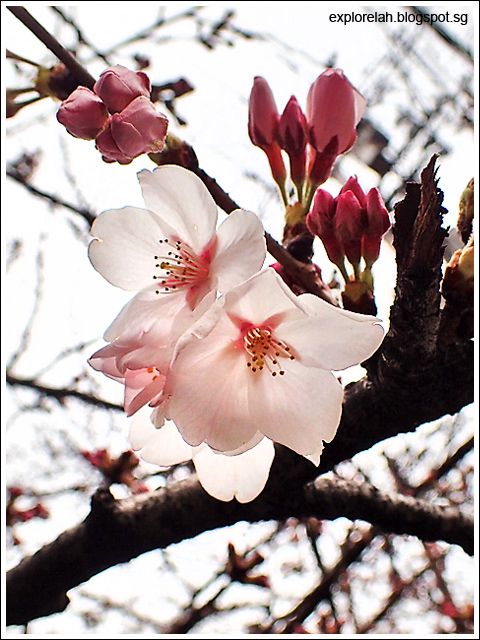
It is always such a joy to discover sakuras in bloom. This is the pink variety of the five-petaled Yamazakura. This species sprouts leaves the same time as its flowers bud and bloom.

Having a Little Red Riding Hood moment in the enchanted sakura forest. LOL

I wood always love you... Yup, I'm smitten by the classic wooded facade of olden day Jap architecture.

Doing my best interpretation of Spirited Away.

Getting in on the minimalist chic-Zen movement of Japan by cam-whoring with an uncluttered backdrop.

The bench needed company so I decided to let it feel better by sharing the weight of my loneliness.

A scenic setting for great snaps, Kiyamachi Street and its surrounding grid of streets and tidy back alleys provide a unique backdrop to indulge in narcissism.

We didn't find much things to do here as we did not venture to the nearby market and shopping area and decided to head back to the Gion old quarters to catch the coveted cultural performances by maiko. Exploring Gion and its photogenic nearby districts of Kiyamachi Street and Shirakawa Area is definitely a time opportunity in Japan not to be missed! 
Related Posts Plugin for WordPress, Blogger...